













Armchair Scientists Can Work on Medical Breakthroughs

The key to unlocking a cure for cancer might be sitting in your den or home office.
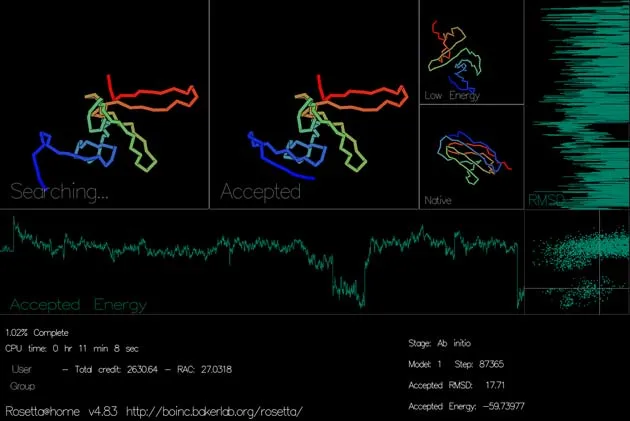
Modeled after the groundbreaking and wildly popular SETI@home project, scientists have conceived Rosetta@home to harness the power of PCs to solve basic problems in medicine.
Rosetta@home plans to use the extensive number-crunching power of computer time donated by tens of thousands of individuals to hopefully unravel basic mysteries of proteins, the building blocks of life.
Understanding how proteins form complex structures can help scientists better understand diseases such as cancer, malaria and HIV, project scientists said today.
The project is already building models of the anthrax toxin in work that could contribute to the development of treatments.
“This is a way that people from all backgrounds can now make important contributions to progress in science and medicine,” said David Baker, a biochemist at the University of Washington and the Howard Hughes Medical Institute and leader of the project. “Rosetta@home seeks to solve one of the longest standing problems in molecular biology, with important implications for human health and the treatment of disease."
Through a process called distributed computing, the project will take a massive calculation, break it into chunks, and send the pieces across the Internet to be processed by PCs. Then the entire problem is re-assembled at a central computer.
Get the world’s most fascinating discoveries delivered straight to your inbox.
A similar project is using home computers to model climate change scenarios.
More information about Rosetta@home is available here.
- The Greatest Modern Minds
- Dinosaur Tumor Studied for Human Cancer Clues
- Leonardo Da Vinci's 10 Best Ideas
- The Biggest Popular Myths

Robert is an independent health and science journalist and writer based in Phoenix, Arizona. He is a former editor-in-chief of Live Science with over 20 years of experience as a reporter and editor. He has worked on websites such as Space.com and Tom's Guide, and is a contributor on Medium, covering how we age and how to optimize the mind and body through time. He has a journalism degree from Humboldt State University in California.