It's quick and easy to access Live Science Plus, simply enter your email below. We'll send you a confirmation and sign you up for our daily newsletter, keeping you up to date with the latest science news.
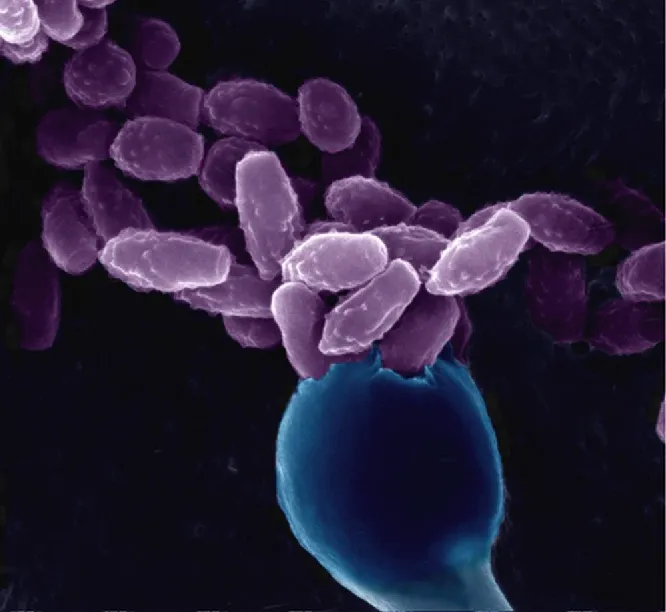
Scanning electron micrograph of infectious yeast spores (purple) on the surface of the structure where they are produced following sexual reproduction (in blue, the basidium).
(Image credit: Chaoyang Xue, Kasey Carroll, and Joseph Heitman, Duke University)
A fungus that causes a deadly brain infection has a curious mating strategy, in which it reproduces with clones of itself, a new study finds.
Most species that reproduce sexually produce offspring that are a genetic mix of two different parents. But the yeast Cryptococcus neoformans produces offspring "unisexually," from two identical parents. These offspring have additional copies of certain chromosomes, or threadlike structures that carry DNA, creating genetic diversity from scratch, study researchers say.
Sexual reproduction exists to increase the genetic diversity of a species, making it more adaptable to different environments. But sex comes at a price, requiring two individuals to spend energy and resources looking for a mate. [Microscopic Worlds Gallery: Fascinating Fungi]
"Normally, it takes two parents that are genetically different from each other, and the offspring are recombinants," or genetic combinations, said study researcher Joseph Heitman, a molecular biologist at Duke University in Durham, N.C. "But if there's no pre-existing genetic diversity to mix up, what would be the function of the unisexual cycle?"
C. neoformans has two sexes, known as "a" and "alpha." An "a" and "alpha" can reproduce sexually (with each other), but since the vast majority of individuals are the alpha type, they were thought to reproduce asexually (from one individual). Then, in 2005, Heitman and his colleagues found that two genetically identical alpha yeast could reproduce together — unisexually.
Light microscopy view showing the four chains of infectious spores that decorate the basidium where meiosis occurs and the spores are produced by budding from the apical surface.
(Image credit: Joseph Heitman and colleagues, Duke University)
Yeast sexual pairings often result in offspring with multiple copies of a chromosome, known as aneuploidy. This condition is associated with several human disorders, particularly Down syndrome, which results from having an extra copy of chromosome 21. But in fungi, aneuploidy can confer advantages, such as resistance to anti-fungal treatment.
In the new study, Heitman and his colleagues found that C. neoformans clones produced offspring that had traits different from their parents', such as drug resistance or pigmentation. The majority of those offspring had extra copies of chromosomes.
Sign up for the Live Science daily newsletter now
Get the world’s most fascinating discoveries delivered straight to your inbox.
Some of the yeast later lost the extra chromosomes and became identical to their parents, suggesting the extra copies were responsible for the diversity of traits seen in the baby yeasts.
The yeast was reaping the benefits of sexual reproduction without some of the costs associated with sex, the researchers reported today (Sept. 10) in the journal PLOS Biology.
"This study pulls a lot of the pieces together into one coherent story," said microbiologist Richard Bennett of Brown University in Providence, R.I., who was not involved with the research. His own team has found that another yeast, called Candida albicans, also reproduces unisexually and produces aneuploid offspring. Whereas scientists had theorized that aneuploidy might yield diverse offspring, Heitman's team put everything together, Bennett told LiveScience.
In humans, C. neoformans can cause a life-threatening infection of the membranes that surround the brain. Most people are exposed to the fungus, but the infection generally strikes people with weakened immune systems. The pathogen causes more than 600,000 deaths a year, and is responsible for a third of all AIDS-related deaths.
Understanding how the yeast reproduces could eventually lead to better anti-fungal treatments, Heitman said.
Tanya was a staff writer for Live Science from 2013 to 2015, covering a wide array of topics, ranging from neuroscience to robotics to strange/cute animals. She received a graduate certificate in science communication from the University of California, Santa Cruz, and a bachelor of science in biomedical engineering from Brown University. She has previously written for Science News, Wired, The Santa Cruz Sentinel, the radio show Big Picture Science and other places. Tanya has lived on a tropical island, witnessed volcanic eruptions and flown in zero gravity (without losing her lunch!). To find out what her latest project is, you can visit her website.