















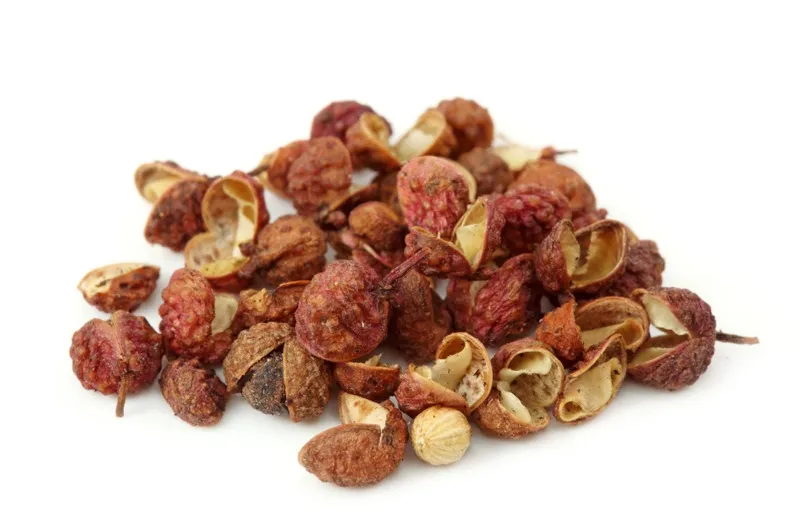
Most people who have eaten spicy Chinese food know the distinctive tingly numbness caused by Sichuan peppers.
Now research, detailed today (Sept. 10) in the journal Proceedings of the Royal Society B, explains why Sichuan peppers cause those tingles — they activate sensors in the lips that respond to light touch.
The findings may help researchers understand exactly why humans perceive certain taste experiences as they do, said study co-author Nobuhiro Hagura, a cognitive neuroscientist at the University College London. [The 7 (Other) Flavors Humans May Taste]
Chinese pepper
Sichuan peppers, Zanthoxylum piperitum, grow throughout China and the Himalayas. The seeds of the plant are often added to foods throughout the region, and often cause a tingly, numb sensation on the lips, similar to a slight electrical current.
Past research suggested the active tingle-stimulating ingredient in Sichuan peppers was a chemical called sanshool. Other natural chemicals, such as menthol and capsaicin in hot chili peppers, activate sensors in the tongue that detect heat and cold. Though research found that sanshool activates nerves that sense touch, exactly how it did so wasn't clear.
To find out, Hagura and his colleagues put ground Sichuan pepper on the lips of 28 men.
Get the world’s most fascinating discoveries delivered straight to your inbox.
After a few minutes, the men's lips began to feel numb and tingly. The team then used a machine to mechanically vibrate participants' fingers, and asked them if the vibrational frequency on the finger was faster or slower than the tingle on their lips.
The peppers caused the sensation of about 50 vibrations per second, which corresponds to the frequency sensed by nerves that sense light touches on the skin.
Touch and taste
The findings could help broaden the understanding of how signals in the skin are translated into complex touch sensations in the brain, Hagura said.
It could also help scientists understand how touch plays into taste perception. Sichuan peppers don't add much flavor to food, so their main draw must be the tactile sensations they provide, Hagura said.
"This may offer an opportunity to understand how the quality of touch can alter the perceived taste," Hagura told LiveScience.
Follow Tia Ghose on Twitter and Google+. Follow LiveScience @livescience, Facebook & Google+. Original article on LiveScience.

Tia is the editor-in-chief (premium) and was formerly managing editor and senior writer for Live Science. Her work has appeared in Scientific American, Wired.com, Science News and other outlets. She holds a master's degree in bioengineering from the University of Washington, a graduate certificate in science writing from UC Santa Cruz and a bachelor's degree in mechanical engineering from the University of Texas at Austin. Tia was part of a team at the Milwaukee Journal Sentinel that published the Empty Cradles series on preterm births, which won multiple awards, including the 2012 Casey Medal for Meritorious Journalism.