













Daring to Trap Grizzlies, Researchers Tackle Population Puzzle

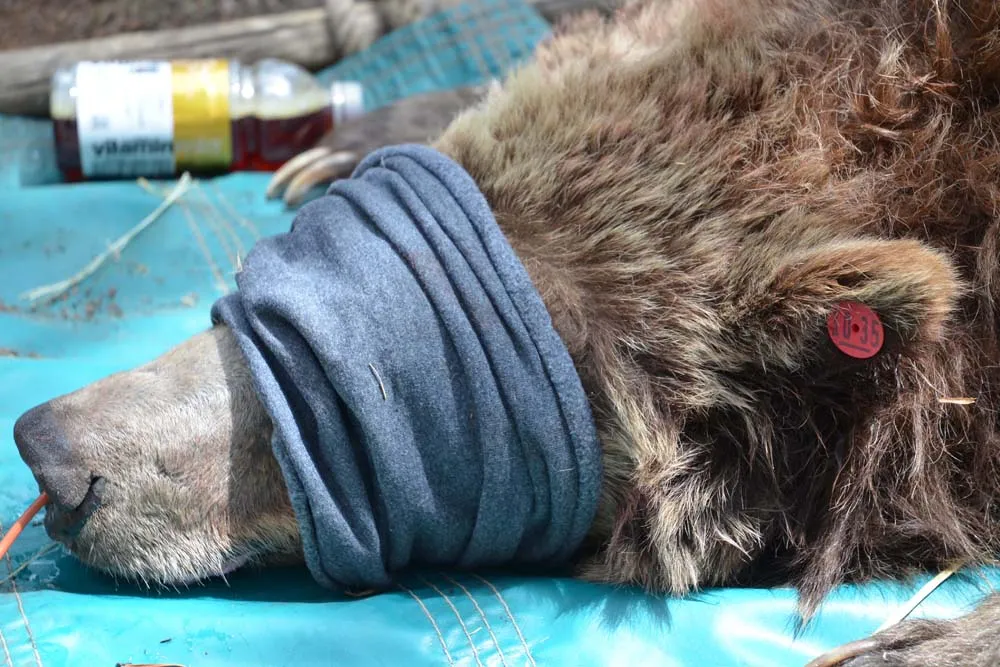
It takes a trained team, a healthy dose of caution and about an hour of work to restrain a grizzly bear and get the samples needed for research on the iconic western species. This research that could help scientists solve a puzzling trend in the bear's population numbers.
Here's how it works: Researchers scout out an area where grizzlies are known to wander. There, scientists leave roadkill bait in a metal box-trap, masked so the bears can't detect it. Once the trap catches a grizzly, scientists use a sedative to immobilize the animal. Then, they have only an hour to take blood and hair samples, do some measurements and fit a radio collar on the animal before it wakes up.
A team led by the U.S. Geological Survey (USGS) goes through this complicated procedure in the Yellowstone National Park area about 70 to 100 times a year. Despite the inherent danger, the research is a critical means of gleaning information about the local grizzly population's health.
"The safety of the animal is important, as well as the safety of our research teams," said Frank van Manen, a researcher with the USGS who leads the interagency team.
"You are working with a wild animal — a very powerful wild animal. Obviously, there's always a risk of something happening that we haven't seen before, so vigilance is incredibly important here." [7 Iconic American Animals]
Population growth flattens
Researchers have conducted grizzly bear monitoring in various forms since 1973. At that time, Yellowstone was completing the closures of garbage dumps that had attracted bears. Because of these dumps, the grizzlies started roaming for food in areas too close to the park's tourists, leading to policies of euthanization and removal.
Surveys showed a decline in the grizzly population until the early 1980s. Then, between 1983 and the early 2000s, the overall population increased by somewhere between 4 percent and 7 percent a year. (Grizzlies are slow reproducers; they have two cubs once every three years, and only become fertile at age four or five.)
Get the world’s most fascinating discoveries delivered straight to your inbox.
That growth has leveled off, however, in the past decade. Current growth is estimated to be only as high as 2 percent a year. Figuring out why is one of the reasons grizzly scientists are trapping and studying the bears. [Photos: Trapping Grizzly Bears
"We estimate 600 to 700 bears in this population. Is it possible that we now have reached a density where the population is being affected by what we call density dependent effect?" van Manen said, naming one question the scientists are asking. This occurs when the growth of the population itself regulates its own size. In the specific case of the grizzlies, he added, this would mean that the older males are killing the young cubs.
Scientists have proposed competing theories on what's causing the population to level off, however. One of the explanations focuses on whitebark pine, an important food as grizzlies bulk up for hibernation in the fall. Grizzlies eat caches of whitebark pine seeds embedded in the tree.
Climate change effect?
Van Manen's team completed surveys of the whitebark pine population, finding a marked decrease (74 percent) in the number of trees in the past few years. As these pines are high-altitude trees, growing best above 8,000 feet (about 2,400 meters), some have proposed that the warming climate might facilitate outbreaks of native mountain pine beetles, which kill off the trees. Climate change could mean the trees' high altitude can't protect them from infestations any longer.
"The winter temperatures aren't cold enough to break the cycle for the beetles. One hypothesis is that we're going to see more frequent outbreaks and more severe outbreaks," van Manen said.
It's unclear how greatly this is affecting the grizzly bears, though. In response to lost pine trees, the animals could switch to eating more meat or find other plants as a substitution, van Manen said.
The researcher's team has submitted a paper examining the body composition and fat content of grizzlies over time, taken from the samples obtained when the scientists trap the grizzlies. While van Manen declined to give specifics about the results until they are published, he said there are "no major indications" that body fat as a percentage of bear weight is declining This could, with further study, suggest that the food source isn't the explanation.
Other participants in the ongoing bear research study include the U.S. Forest Service, the U.S. Fish and Wildlife Service, the Wind River tribe, and the wildlife agencies for Idaho, Montana, Wyoming.
Follow Elizabeth Howell @howellspace, or LiveScience on Twitter @livescience. We're also on Facebook & Google+.

Elizabeth Howell was staff reporter at Space.com between 2022 and 2024 and a regular contributor to Live Science and Space.com between 2012 and 2022. Elizabeth's reporting includes multiple exclusives with the White House, speaking several times with the International Space Station, witnessing five human spaceflight launches on two continents, flying parabolic, working inside a spacesuit, and participating in a simulated Mars mission. Her latest book, "Why Am I Taller?" (ECW Press, 2022) is co-written with astronaut Dave Williams.