US Weather Service Beefs Up Computing Power for Better Forecasts
Get the world’s most fascinating discoveries delivered straight to your inbox.
You are now subscribed
Your newsletter sign-up was successful
Want to add more newsletters?
Delivered Daily
Daily Newsletter
Sign up for the latest discoveries, groundbreaking research and fascinating breakthroughs that impact you and the wider world direct to your inbox.
Once a week
Life's Little Mysteries
Feed your curiosity with an exclusive mystery every week, solved with science and delivered direct to your inbox before it's seen anywhere else.
Once a week
How It Works
Sign up to our free science & technology newsletter for your weekly fix of fascinating articles, quick quizzes, amazing images, and more
Delivered daily
Space.com Newsletter
Breaking space news, the latest updates on rocket launches, skywatching events and more!
Once a month
Watch This Space
Sign up to our monthly entertainment newsletter to keep up with all our coverage of the latest sci-fi and space movies, tv shows, games and books.
Once a week
Night Sky This Week
Discover this week's must-see night sky events, moon phases, and stunning astrophotos. Sign up for our skywatching newsletter and explore the universe with us!
Join the club
Get full access to premium articles, exclusive features and a growing list of member rewards.
The National Oceanic and Atmospheric Administration's National Weather Service just revved up its computer power considerably: The agency's two supercomputers (appropriately named "Tide" and "Gyre") are now operating with 213 teraflops (TF), up from the 90 TF. That means that they can perform 213 trillion calculations per second.
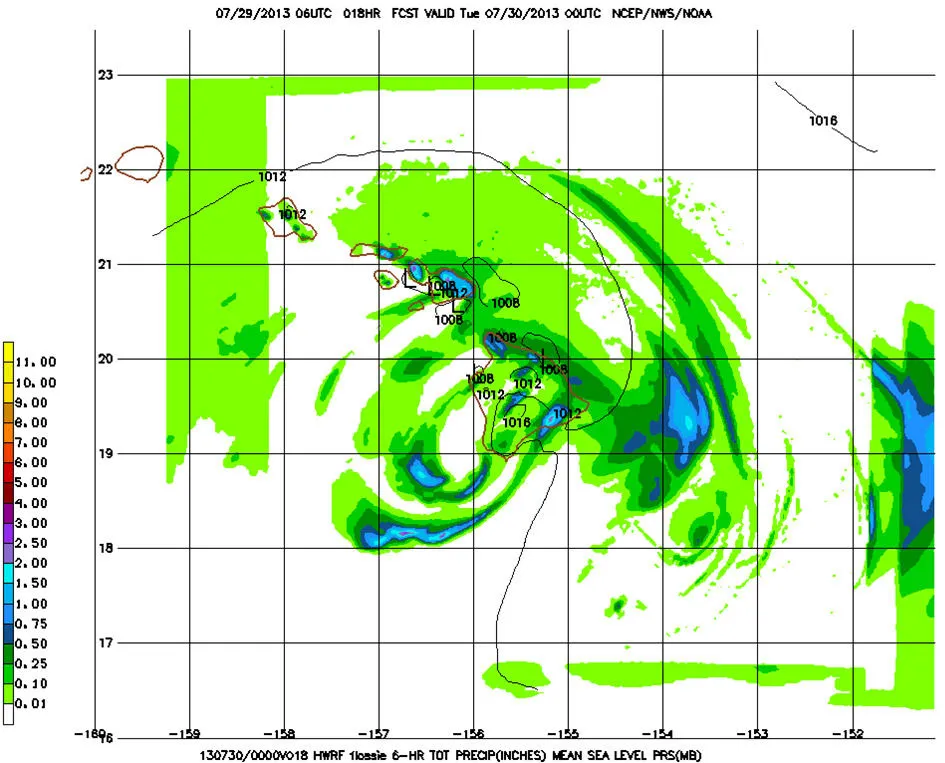
The aim of the amped up computing power is to provide more accurate forecasts that extend further out in time, according to a NOAA release. For example, the agency is going to use the computer to run an improved version of their Hurricane Weather Research and Forecasting (HWRF) model, which shows a 15 percent improvement in forecasting storm tracks and intensity over last year's version, the agency notes.
"Given recent events like the tornado in Moore, Okla., or Superstorm Sandy, federal weather resources and personnel should be considered vital national assets," J. Marshall Shepherd Ph.D., a meteorologist at the University of Georgia and president of the American Meteorological Society, said in the statement.
And NOAA isn't stopping there. By 2015, officials hope to have computing power up to a whopping 1,950 TF.
Follow Andrea Thompson @AndreaTOAP, Pinterest and Google+. Follow us @livescience, Facebook & Google+.
Get the world’s most fascinating discoveries delivered straight to your inbox.

Andrea Thompson is an associate editor at Scientific American, where she covers sustainability, energy and the environment. Prior to that, she was a senior writer covering climate science at Climate Central and a reporter and editor at Live Science, where she primarily covered Earth science and the environment. She holds a graduate degree in science health and environmental reporting from New York University, as well as a bachelor of science and and masters of science in atmospheric chemistry from the Georgia Institute of Technology.