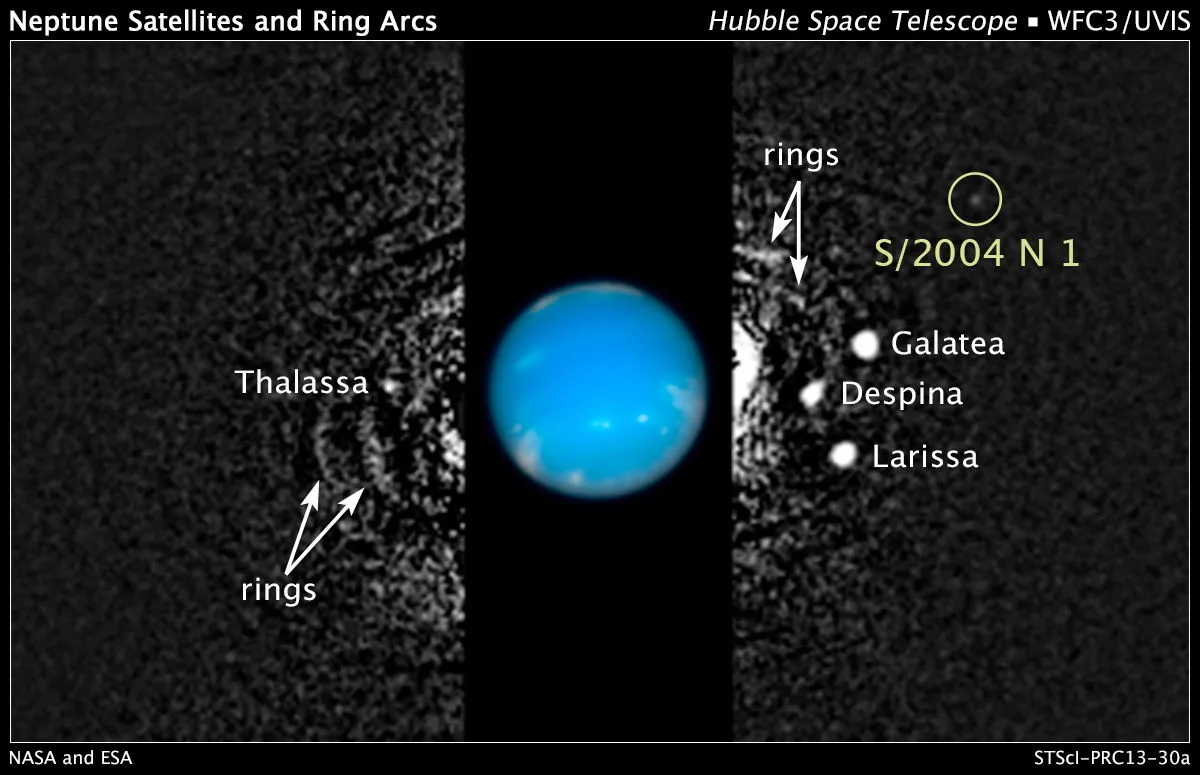
This composite Hubble Space Telescope picture shows the location of a newly discovered moon, designated S/2004 N 1, orbiting the giant planet Neptune, nearly 3 billion miles from Earth. Image released July 15, 2013.
(Image credit: NASA, ESA, and M. Showalter (SETI Institute))
The Hubble Space Telescope has revealed a small, never-before-seen moon around Neptune, boosting the giant blue planet's total satellite count to 14 satellites, new photos reveal.
The newfound Neptune moon — called S/2004 N 1 — was discovered July 1 during a fresh analysis of older Hubble Space Telescope images, scientists said. The newly discovered satellite is Neptune's smallest known moon and is just 12 miles (19 kilometers) wide.
Compass and scale image for the newly discovered moon of Neptune, S/2004 N 1. Image released July 15, 2013.
(Image credit: NASA, ESA, and Z. Levay (STScI/AURA))
"The moons and arcs [segments of rings around the planet] orbit very quickly, so we had to devise a way to follow their motion in order to bring out the details of the system," SETI Institute scientist Mark Showalter, the moon's discoverer, said in a statement. "It's the same reason a sports photographer tracks a running athlete — the athlete stays in focus, but the background blurs."
In order to find the moon, Showalter dug through archival photos taken by Hubble from 2004 to 2009. The newly found moon appears in about 150 of those photos. By plotting a circular orbit of the moon, Showalter saw that the tiny satellite fully orbits Neptune every 23 hours.
The tiny moon is so small and hard to see that it even evaded NASA's Voyager 2 spacecraft when it flew by Neptune in 1989. At the time, Voyager 2 revealed six previously unknown moons in orbit around the blue planet, NASA officials have said.
S/2004 N 1 is so small that it's about 100 million times fainter than the dimmest star that can be seen with the naked eye, NASA officials said.
Sign up for the Live Science daily newsletter now
Get the world’s most fascinating discoveries delivered straight to your inbox.
At 1,680 miles (2,700 km) across, Neptune's biggest moon is Triton. It is the only large moon in the solar system that has a retrograde orbit, meaning that it orbits in the opposite direction of its host planet's rotation, scientists have found.
Because of this strange orbit, some experts suspect that Triton is a dwarf planet caught in Neptune's gravitational pull.
This diagram shows the orbits of several moons located close to the planet Neptune. All of them were discovered in 1989 by NASA's Voyager 2 spacecraft, with the exception of S/2004 N 1, which was discovered in archival Hubble Space Telescope images taken from 2004 to 2009. Image released July 15, 2013.
(Image credit: NASA, ESA, and A. Feild (STScI))
"This capture would have gravitationally torn up any original satellite system Neptune possessed," Hubble officials wrote in a statement. "Many of the moons now seen orbiting the planet probably formed after Triton settled into its unusual retrograde orbit about Neptune."
The Hubble Space Telescope launched in 1990 and has been beaming back amazing images of celestial sights ever since. NASA officials hope to keep the venerable space telescope in operation until at least 2018 when its successor, the James Webb Space Telescope, is expected to launch.
This story was provided by SPACE.com, a sister site to LiveScience. - See more at: http://www.livescience.com/38154-sun-solar-weather-peak-is-weak.html#sthash.CA6qZpRC.dpuf
Miriam Kramer joined Space.com as a staff writer in December 2012. Since then, she has floated in weightlessness on a zero-gravity flight, felt the pull of 4-Gs in a trainer aircraft and watched rockets soar into space from Florida and Virginia. She also serves as Space.com's lead space entertainment reporter, and enjoys all aspects of space news, astronomy and commercial spaceflight. Miriam has also presented space stories during live interviews with Fox News and other TV and radio outlets. She originally hails from Knoxville, Tennessee where she and her family would take trips to dark spots on the outskirts of town to watch meteor showers every year. She loves to travel and one day hopes to see the northern lights in person.