What Caused Ancient Upheaval to Australian Landscape?

Between about 45,000 and 50,000 years ago, Australia experienced three radical changes. The continent was once home to a menagerie of giant creatures, or megafauna, such as marsupial versions of lions, rhino-size wombats, giant kangaroos and flightless birds, but about 90 percent of that megafauna disappeared during this time. A major, relatively brief shift in plant life — from grasses to trees — occurred during this period as well. And last but not least, humans colonized Australia during this period.
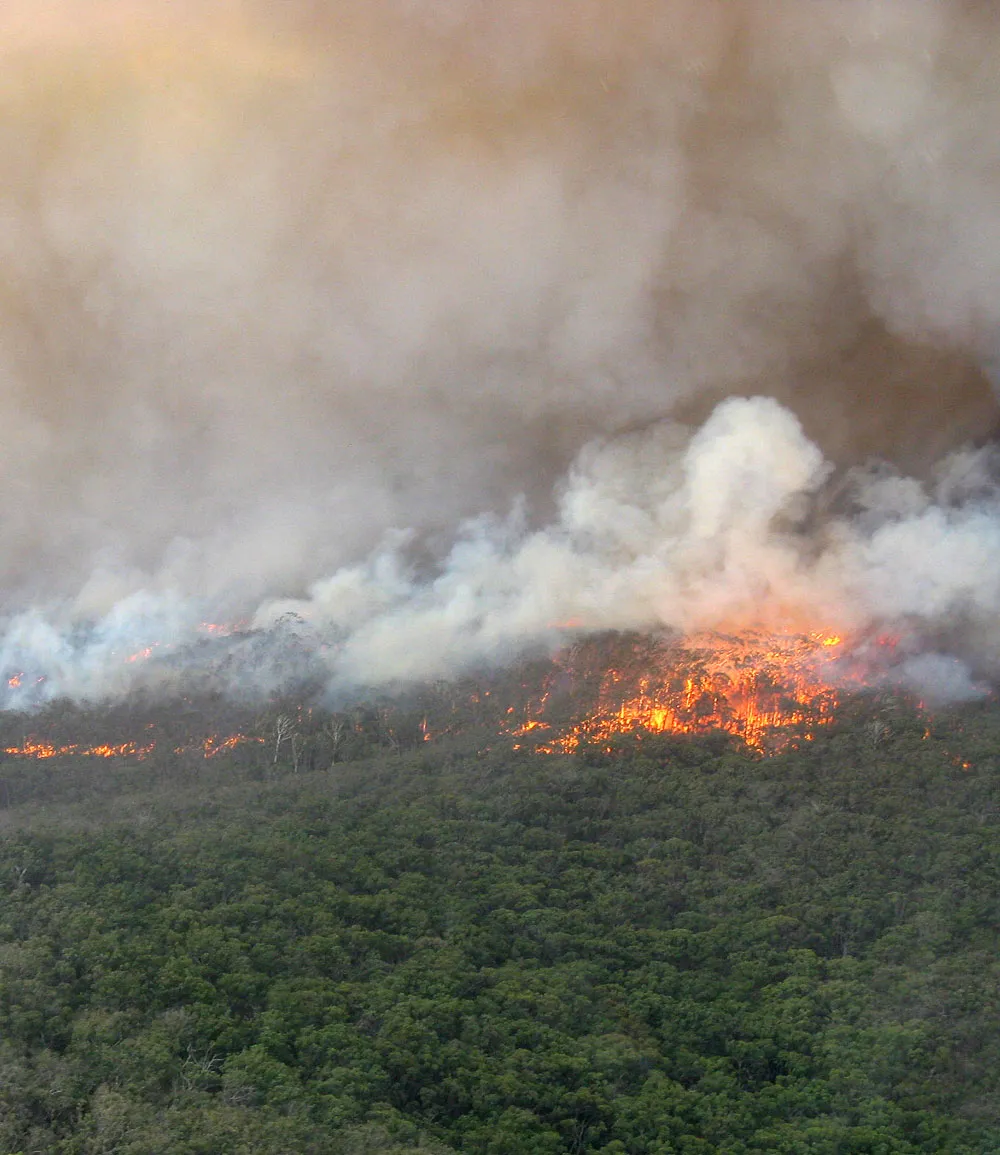
Because the arrival of humans coincided with dramatic changes in the animal and plant life of Australia, many scientists have speculated that humans impacted the continent's flora and fauna. For instance, humans may have burned the land, perhaps accidentally, or to concentrate game animals. This shift in plant life would have driven these plant-dependent herbivores —as well as the carnivores that preyed on those herbivores —to extinction.
However, other scientists have suggested different explanations for these changes. For instance, the extinction of many plant-eating megafauna in Australia could have triggered major upsets when it came to which plants dominated the continent.
To shed light on this mystery, a team of investigators have reconstructed past changes in vegetation by looking at ancient sediment from the Murray Canyons Group region offshore southern Australia. This material was deposited by a river system that once covered more than 425,000 square miles (1.1 million square kilometers) of southeastern Australia —an area that was home to many of the megafauna that became extinct. What they found suggests that fire-wielding humans weren't to blame for the drastic shift in the makeup of the landscape. [Wipe Out: History's Most Mysterious Extinctions]
Carbon signatures
The scientists focused on isotopes of carbon in plant waxes found in ancient soils and sediments. Carbon isotopes differ in how many neutrons they possess in their atomic nuclei — carbon-12 has six neutrons, while carbon-13 has seven. (Both have six protons.)
The kinds of grasses that dominate northern Australia today have adapted to warmer, dryer conditions and mostly practice a kind of photosynthesis known as C4, which uses both carbon-12 and the heavier carbon-13 isotope. On the other hand, trees and shrubs that have adapted to cooler, wetter conditions depend on a type of photosynthesis known as C3, which also takes up carbon-12 and carbon-13 but prefers carbon-12. By analyzing the ratios of these different carbon isotopes within plant waxes, the researchers could infer what plants dominated the region at different times in the past.
Get the world’s most fascinating discoveries delivered straight to your inbox.
The scientists also looked for an organic compound known as levoglucosan. This molecule is exclusively generated during the burning of land vegetation, so its presence would bolster the idea that humans changed the landscape with fire.
The results of the study showed that about 44,000 to 58,000 years ago, C4 plants apparently dominated the region much as they do today, making up 60 to 70 percent of the vegetation there. However, by 43,000 years ago, C4 plants made up only 40 percent of the vegetation there. There was a matching rise in C3 plants that lasted for about 5,000 years.
Which came first?
This shift in plant life probably came after the megafauna extinction about 44,000 to 49,000 years ago, not before it, the study researchers suggest. This may rule out the human use of fire as the cause of those mass deaths.
Instead, this discovery hints that an extinction of megafauna herbivores that normally browsed on C3 plants, allowing trees and shrubs to rise in dominance. This, in turn, led more fire-prone vegetation to build up in the Australian landscape, the researchers said.
"In 150,000 years of climate change in southeastern Australia, lots of changes in the vegetation took place, but none was so strong and abrupt as the change 43,000 years ago caused by the extinction," researcher Stefan Schouten, a geochemist at the NIOZ Royal Netherlands Institute for Sea Research, told LiveScience.
Scientists still aren't certain what caused the extinction of Australia's megafauna herbivores in the first place. Humans remain one potential culprit for the megafauna extinction — they did arrive on the continent about 45,000 to 54,000 years ago, before this shift in the region's plant life, which suggests they could have caused the demise of the megafauna that led to the plant upheaval.
The scientists detailed their findings online June 30 in the journal Nature Geoscience.
Follow us @livescience, Facebook & Google+. Original article on LiveScience.com.