













Close Human Relative Nearly Extinct

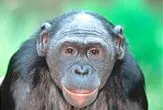
A close relative to the chimpanzee that is thought to be the closest human relative may be on the verge of extinction, scientists say.
Bonobos, or pygmy chimpanzees, have been hunted so extensively that their survival is at risk, warn officials at the World Wildlife Fund.
"The world could soon lose the primate species that shares the greatest genetic connection to humans," said Richard Carroll, a primatologist and director of WWF's Central Africa program. "Bonobos are fascinating creatures and little understood. They have the only great ape society led by females, with a sophisticated social structure that encourages cooperation and peace and settles disputes through sex."
Found only in the war-torn Democratic Republic of Congo in Central Africa, bonobos were believed to once number as many as 50,000. But preliminary results from the first systematic survey of a known bonobo stronghold found more evidence of poachers than bonobos, indicating that there may be as few as 10,000 left in the wild.
Bonobos, along with other species, are targeted by hunters for meat for personal consumption and for the commercial bushmeat trade.
The survey was conducted in Congo's 90,000-square-mile Salonga National Park, a protected area the size of Holland. The first data available, from about a third of the park, show evidence of very few bonobos. No bonobos were encountered, and nests and dung were seen in only a quarter of the area surveyed, at lower densities than previously measured.
"These preliminary results are obviously disturbing," Carroll said. "Salonga National Park was created in 1970 specifically to safeguard bonobos and we thought it was the least disturbed and best protected habitat for the bonobo. Based on how bad it looks here, we can assume that across the Congo, bonobos are in crisis."
Get the world’s most fascinating discoveries delivered straight to your inbox.
Photo Credit: WWF-Canon / Martin Harvey
