













New Machine Pumps Disembodied Heart

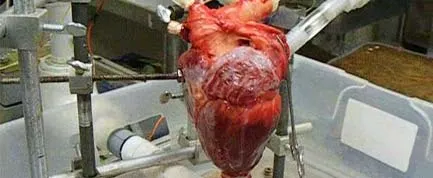
After a pig's final oink, a new machine can pump the dead animal's extracted heart so that the muscle beats much like the live one did, scientists say.
The machine, created by researchers at North Carolina State University, can help scientists experiment with new technologies for heart surgery without sacrificing the time and money usually needed to perform research on live animals or carry out a clinical trial.
Before medical devices can be used in heart surgery, they are tested on live pigs because their heart valves are very similar to human valves. But these studies are expensive and scientists need to get permission to use live animals for their research, which takes time.
The new pump, called a "dynamic heart system," lets researchers test their tools for much less money, only about $25 instead of the usual $2,500 it costs to experiment with living animals, said Andrew Richards, a Ph.D. student in mechanical engineering at NC State and the system's designer. And instead of going through the lengthy permission process to test with live pigs, researchers can acquire pig hearts from a pork processing facility, he said.
"We used pig hearts that were approximately the same size as human hearts," Richards told LiveScience, in reference to the size of the hearts used when developing and testing the dynamic heart system.
The hearts come from nearby slaughterhouses, he said, adding: "If you preserve them properly, there is really no limit on how long they can be kept before use. Because we can get them so easily, due to our proximity to slaughterhouses, ours tended to be fairly fresh."
A report on the heart system research, which was funded by the National Heart, Lung and Blood Institute, was published in the April 2009 issue of journal Annals of Biomedical Engineering.
Get the world’s most fascinating discoveries delivered straight to your inbox.
{{ video="LS_090511_HeartCart" title="" caption="" }}
- Video: Disembodied Heart Pump
- Top 10 Amazing Facts About Your Heart
- The Body Quiz 1: The Parts List
