














What's the World's Largest Whale?
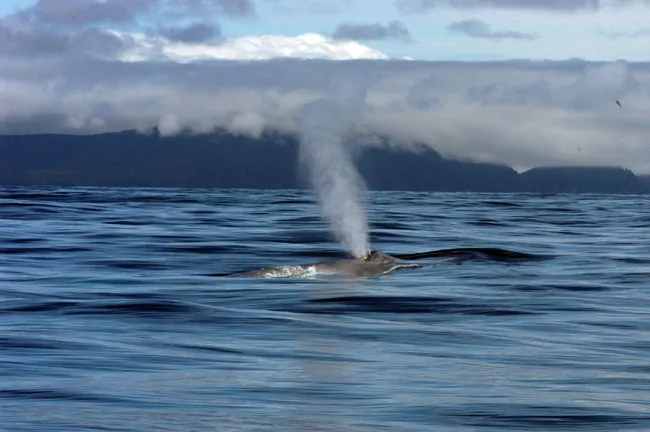
The world’s largest whale is also the largest animal on the planet — the blue whale. At 98 feet in length and 180 metric tons, the blue whale tops even dinosaurs to be the largest animal ever. They filter krill through their baleen, and need 4-8 tons of the tiny plankton per day to survive. Each whale’s jaws contains about 320 pairs of black baleen plates with dark gray bristles. A blue whale tongue alone can weigh as much as an elephant. The animals live to be 80-90 years old and live all around the world’s oceans, spending summers in cold polar waters and winters closer to the Equator.
They cruise the oceans at a speed of about 5 miles per hour, but can accelerate quickly to 20 mph when they need to. Water carries sound efficiently, and other whales living 1,000 miles away can hear the creaks, squeaks and groans that blue whales make underwater.
Blue whales are endangered, and there may be only about 5,000-12,000 remaining around the globe. They were once plentiful, but whalers made quick work of slaughtering the gentle giants. In 1966, the International Whaling Commission declared them to be a protected species in 1966 because of a huge decrease in their population. Other than humans, their main predators have been packs of orca whales that sometimes attack and kill young blue whales.
The enormous whales breathe air at the surface of the water through two blowholes located near the top of the head. While they’re resting, the whales spout about 1-4 times per minute, and 5-12 times per minutes after a deep dive. When they blow out their breath, the stream rises 40-50 feet above the surface of the water.
Follow Life's Little Mysteries on Twitter @llmysteries. We're also on Facebook & Google+.
Get the world’s most fascinating discoveries delivered straight to your inbox.