














What's the World's Largest Crocodile?
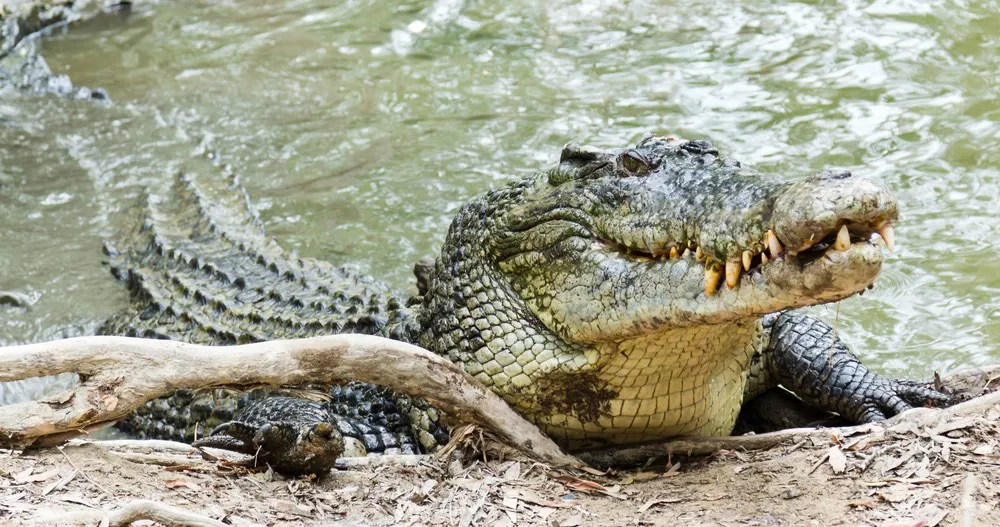
Get ready for some nightmares. The world's largest crocodile is a monster of a reptile.
Named Cassius, this nearly 18-foot-long (5.48 meters) Australian saltwater crocodile (Crocodylus porosus) was crowned the world's largest captive croc by Guinness World Records on Jan. 1, 2011. The animal lives at Marineland Melanesia on Green Island, off the coast of Cairns in Queensland. The more than 100-year-old beast has quite the appetite, with Marineland keepers feeding him chicken, fish and pork, according to the park's website.
Cassius, who tips the scales at more than a ton (nearly 1,000 kilograms), lost his record for about a minute in late 2011. That's when Lolong, a saltwater crocodile caught in the Bunawan province of the Philippines, measured in at a whopping 20.24 feet (6.17 meters)
Croc hunters spent three weeks to find and capture Lolong; about 100 people were needed to take the monster croc, which twice broke free of ropes to help with the effort, out of the water. In fact, once out, Lolong had to be rolled on a cart to a bridge weighing station to determine his reptilian bulk: 2,370 lbs. (1,075 kg).
Lolong, who was estimated to be 50 years old at the time, was a major-crimes suspect in two disappearances: a young girl's death in early March 2009, and later the disappearance of a fisherman close to Bunawan Village. In an examination of the stomach contents after Lolong's capture, scientists found remnants of water buffaloes reported missing before Lolong's capture, but no human remains. [Images: Alligators vs. Crocodiles]
On Feb. 10, 2013, Lolong died in captivity at Davao Crocodile Park on the Philippine island of Mindanao, according to CNN.
Since the Guinness World Record for largest croc applies to living animals, Lolong lost his badge of honor and Cassius was again crowned the world's largest living crocodile in captivity.
Get the world’s most fascinating discoveries delivered straight to your inbox.
Saltwater crocodiles like these Guinness champs are not picky eaters, it seems, and as they get bigger the variety of prey they can gobble up increases. "Small crocodiles feed frequently on small prey, such as insects and crustaceans, whereas larger individuals feed less often and on bigger prey, including water birds, sea turtles, and mammals up to the size of water buffalo," according to the Australian Museum. They also can be cannibals, the museum said. And the larger crocodiles, as apex predators, will most likely consider humans in their vicinity fair prey.
"A person seized in the water by an Estuarine crocodile [saltwater crocodile] has little chance of escaping without serious injury, if at all. Resulting wounds are usually horrific and likely to become infected," the Australian Museum states.
Even so, there's good reason for crocs to be more afraid of humans than humans are of them. Saltwater crocodiles have been deemed endangered by the International Union for Conservation of Nature.
Editor's Note: Live Science's Jeanna Bryner contributed to an update on this article, which was originally published in 2012.