













How Big Was the Biggest Hailstone Ever?

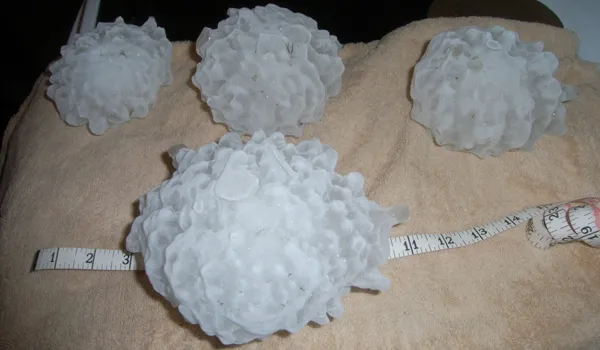
On June 22, 2003, chunks of ice the size of softballs rained down on Aurora, Neb. One, a jagged behemoth with a 7-inch (17.8-centimeter) diameter, entered the record books as the largest U.S. hailstone ever.
Although large in size, it didn't unseat the champion by weight, which fell in Coffeyville, Kan., in 1970, according to the National Center for Atmospheric Research (NCAR). That hailstone weighed more than a pound and a half (0.75 kg).
So how do balls of ice bigger than grapefruit form out of thin air? The answer is in the wind.
Hail forms in the upper reaches of thunder clouds . Super-cooled water comes into contact with an ice crystal or dust particle and freezes, forming the core of a hailstone. Upward-blowing winds called updrafts keep the tiny hailstone aloft. As it hovers in the cloud, the hailstone core acquires more layers of ice. The stronger the updrafts , the more layers the hailstone can accumulate before it falls to earth, and the larger it gets.
Some of the largest hailstones can also from when lots of little hailstones that start to melt and then freeze back together in the atmosphere.
Updrafts blowing at 20 mph (32 kph) are capable of producing pea-sized hailstones, while winds twice as strong can create quarter-sized hail with a 1-inch (2.5 centimeter) diameter.
And as for the softball-sized hailstones that tore apart gutters and left craters in Nebraska cornfields in 2003? Those formed in a tempest with updrafts of at least 100 miles (160 kilometers) per hour.
Get the world’s most fascinating discoveries delivered straight to your inbox.
- Cruel Summer: The Science of Heat Waves
- What Day Had The Most Tornado Strikes?
- How Do Sinkholes Form?
Got a question? Email it to Life's Little Mysteries and we'll try to answer it. Due to the volume of questions, we unfortunately can't reply individually, but we will publish answers to the most intriguing questions, so check back soon.

Stephanie Pappas is a contributing writer for Live Science, covering topics ranging from geoscience to archaeology to the human brain and behavior. She was previously a senior writer for Live Science but is now a freelancer based in Denver, Colorado, and regularly contributes to Scientific American and The Monitor, the monthly magazine of the American Psychological Association. Stephanie received a bachelor's degree in psychology from the University of South Carolina and a graduate certificate in science communication from the University of California, Santa Cruz.