
















New Catfish Species Climbs Rocks

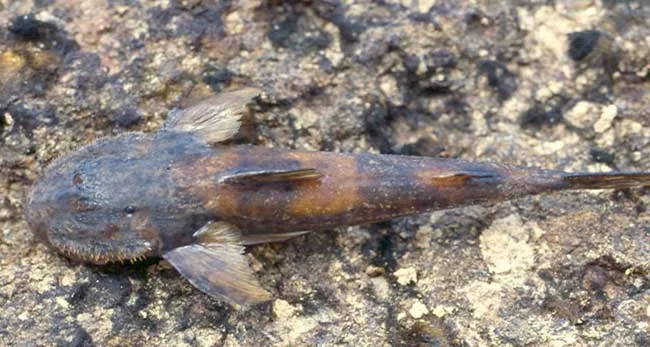
A previously unknown species of climbing catfish has been discovered in remote Venezuela, and its strange traits are shaking the evolutionary tree for these fish. The newfound catfish, Lithogenes wahari, shares traits with two different families of fish — Loricariidae (armored catfishes) and Astroblepidae (climbing catfishes). It has bony armor that protects its head and tail, and a grasping pelvic fin that helps it to climb vertical surfaces such as rocks. These characteristics in L. wahari suggest to ichthyologists Scott Schaefer of the American Museum of Natural History in New York and Francisco Provenzano of the Universidad Central de Venezuela that the common ancestor of the Loricariidae and Astroblepidae probably could grasp and climb rocks with its tail and mouth. Fish in both families, as well as the new catfish, have sucker mouths. The unusual catfish caught the team's attention 20 years ago in Caracas. An anthropologist, Stanford Zent of the Instituto Venezolano de Investigaciones Cientificas, working in the remote state of Amazonas collected samples of local foods and brought them to the Instituto de Zoologíca for identification. "The fish was so strange in morphology that it did not fit into any taxonomic category that we were aware of," Schaefer said. "But it looked like it was run over by a truck. We needed better specimens." It took years to pin down where the fish was found, but the team collected L. wahari after several trips further into the headwaters of the Río Cuao, a tributary of the Río Orinoco. They literally picked 84 specimens off of rocks, where the water level was low at the time. The new samples of L. wahari confirmed that the species is a member of a group that bridges two catfish families. Bony plates on its head and tail, plus other features, link the species to the Loricariidae, the widespread and successful family of fully armored catfishes. But L. wahari also has a specialized pelvic fin that decouples from its body and moves backward and forward independently. This feature — used in combination with a grasping mouth to move like an inchworm up rocks — is otherwise found only in a family of climbing catfish restricted to the Andes, the Astroblepidae. Climbing could be an advantage to these fishes because of the irregular and sometimes high-flow of streams in these elevations.
Schaefer and Provenzano think that L. wahari is the third known species in the subfamily Lithogeninae, and that the specialized features shared among the three species confirms their placement within the family Loricariidae at the base of this large radiation of catfishes. This evolutionary arrangement suggests that the common ancestor to both families probably inhabited upland, rather than lowland, streams of the Amazon and Orinoco river basins, where most of the family diversity is currently found. "We see new fish species all the time, but when you also get new information about the biological history of a group, it's the most fun," Schaefer said. "The question is whether the grasping pelvis and climbing behavior evolved once or if it was independently acquired in these groups. I don't think it evolved twice, although there are slight anatomical differences — so the jury is still out." The paper is published in the latest issue of the journal American Museum Novitates, and the research was supported by the Constantine S. Niarchos Scientific Expedition Fund and the National Science Foundation.
- Video – A Surprising Fish Tale
- Fish — Images and Information
- Gallery: Freaky Fish
Get the world’s most fascinating discoveries delivered straight to your inbox.
