







Why Does Rain Bring a Flood of Earthworms?
Get the world’s most fascinating discoveries delivered straight to your inbox.
You are now subscribed
Your newsletter sign-up was successful
Want to add more newsletters?
Delivered Daily
Daily Newsletter
Sign up for the latest discoveries, groundbreaking research and fascinating breakthroughs that impact you and the wider world direct to your inbox.
Once a week
Life's Little Mysteries
Feed your curiosity with an exclusive mystery every week, solved with science and delivered direct to your inbox before it's seen anywhere else.
Once a week
How It Works
Sign up to our free science & technology newsletter for your weekly fix of fascinating articles, quick quizzes, amazing images, and more
Delivered daily
Space.com Newsletter
Breaking space news, the latest updates on rocket launches, skywatching events and more!
Once a month
Watch This Space
Sign up to our monthly entertainment newsletter to keep up with all our coverage of the latest sci-fi and space movies, tv shows, games and books.
Once a week
Night Sky This Week
Discover this week's must-see night sky events, moon phases, and stunning astrophotos. Sign up for our skywatching newsletter and explore the universe with us!
Join the club
Get full access to premium articles, exclusive features and a growing list of member rewards.
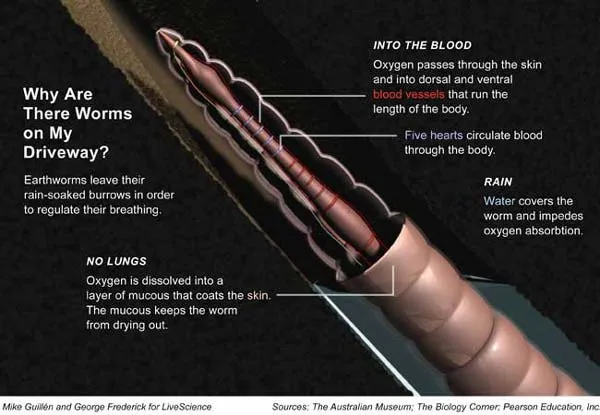
Some rain dances don't occur until showers begin, like the splishy-splashy tip-toe you do around the earthworms on your sidewalk and driveway. Rain causes the worms to leave their drenched burrows and swarm the pavement in order to help regulate their breathing.
It's not that worms don't like to get wet. On the contrary, they need to stay damp in order to breathe properly.
Earthworms don't have lungs. They breathe through their skin. Oxygen dissolves into a mucous coating on a worm's skin then passes through the skin and into blood vessels. The skin must be moist for the oxygen to pass. Special glands secrete the mucous to keep things consistently gooky.
Balance is the key. Too dry is bad: If worms dry, they die. Too wet is bad too: Worms can survive in water for two weeks, but they can't absorb sufficient oxygen from water, and eventually they suffocate.
Why are there so many earthworms on your driveway? Because there can be as many as one million of them under one acre of soil. Step lively!
Follow Life's Little Mysteries on Twitter @llmysteries. We're also on Facebook & Google+.
Get the world’s most fascinating discoveries delivered straight to your inbox.
