














Do All Turtles Have Shells?

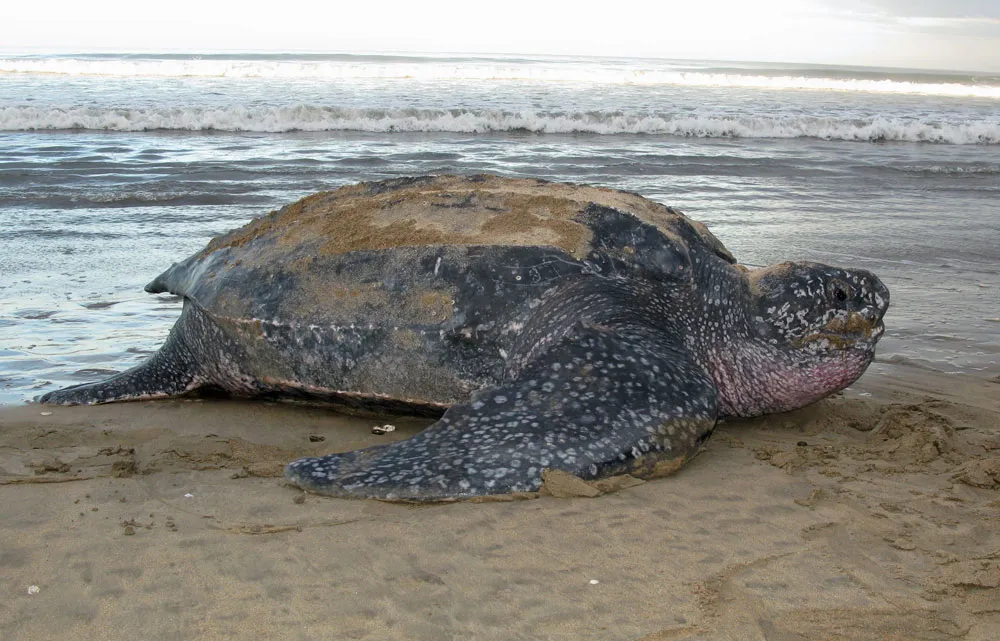
While most turtles sport a hard, protective shell on their backs, leatherback sea turtles have their bony protection embedded under their skin and oily flesh. Hence the name…
Most turtle shells are made of scutes, or hard, bony plates outside the turtle's skin, but the leatherback has mini-plates underneath its thick, leathery skin. It also have seven ridges that run along its back, underneath the skin.
These large sea turtles recently charted one of the longest migrations of any vertebrate animal, and can be found in every ocean of the world.
Follow Life's Little Mysteries on Twitter @llmysteries. We're also on Facebook & Google+.
Get the world’s most fascinating discoveries delivered straight to your inbox.

Andrea Thompson is an associate editor at Scientific American, where she covers sustainability, energy and the environment. Prior to that, she was a senior writer covering climate science at Climate Central and a reporter and editor at Live Science, where she primarily covered Earth science and the environment. She holds a graduate degree in science health and environmental reporting from New York University, as well as a bachelor of science and and masters of science in atmospheric chemistry from the Georgia Institute of Technology.