Ah, summertime — the perfect excuse to set up a gas chromatograph in a rented camper and drive across the country sampling methane.
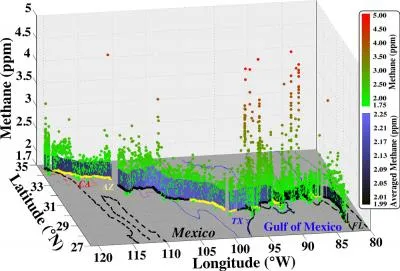
Or at least that's what a team of researchers did in the summer of 2010. The scientists drove across the southern United States and measured levels of methane in the atmosphere along the many roads and highways upon which they traveled.
In many areas, they found higher concentrations of methane than had previously been measured. That's a cause for concern because, among other reasons, methane traps more heat than carbon dioxide, making it a more potent greenhouse gas and thus of concern for global warming, according to a study detailing the trip’s findings and published recently in the journal Atmospheric Environment. (Although methane may be a more potent heat-trapper, carbon dioxide is still the main greenhouse gas of concern because there is much more of it in the atmosphere.)
The team attached a long hose to the front of their RV so their own exhaust fumes wouldn’t contaminate the results. The gas chromatograph onboard then measured the levels of methane along the drive.
Top, the "air ram" intake valve on the RV, shown crossing the Mississippi River. Bottom: the gas chromatograph in the RV.
(Image credit: UCSB)
"We tried to pass through urban areas during nighttime hours, to avoid being stuck in traffic and sampling mostly exhaust fumes," said Ira Leifer, study co-author and researcher at the University of California, Santa Barbara, in a statement from the university. "Someone was always monitoring the chromatograph, and when we would see a strong signal, we would look to see what potential sources were in the area and modify the survey to investigate and, if possible, circumnavigate potential sources."
The researchers traversed cities, swamps and rural areas. They found the highest levels of methane in areas with refineries. As they crossed the Southwest and approached Houston, gas levels gradually increased, the news release noted.
They compared their notes with those from researchers at Germany's University of Bremen, who took measurements using the European Space Agency's Envisat satellite that could also measure methane concentrations over broad areas on the ground. The satellite readings matched their on-the-ground measurements.
Sign up for the Live Science daily newsletter now
Get the world’s most fascinating discoveries delivered straight to your inbox.
Previous studies focused on "large-scale airborne data, which were challenging to separate from local sources," the UC Santa Barbara statement said. The combination of on-the-ground and aerial measurements used in this study helped determine the identity of the methane sources.
The findings could have implications for dealing with global warming."Methane is the strongest human greenhouse gas on a political or short timescale, and also has more bang for the buck in terms of addressing climate change," said Leifer. "This research supports other recent findings suggesting that fugitive emissions from fossil-fuel industrial activity actually are the largest methane source. This clearly indicates a need for efforts to focus on reducing these methane emissions."
Douglas Main loves the weird and wonderful world of science, digging into amazing Planet Earth discoveries and wacky animal findings (from marsupials mating themselves to death to zombie worms to tear-drinking butterflies) for Live Science. Follow Doug on Google+.