














3 Endangered Hawaiian Bird Species Expanding Range

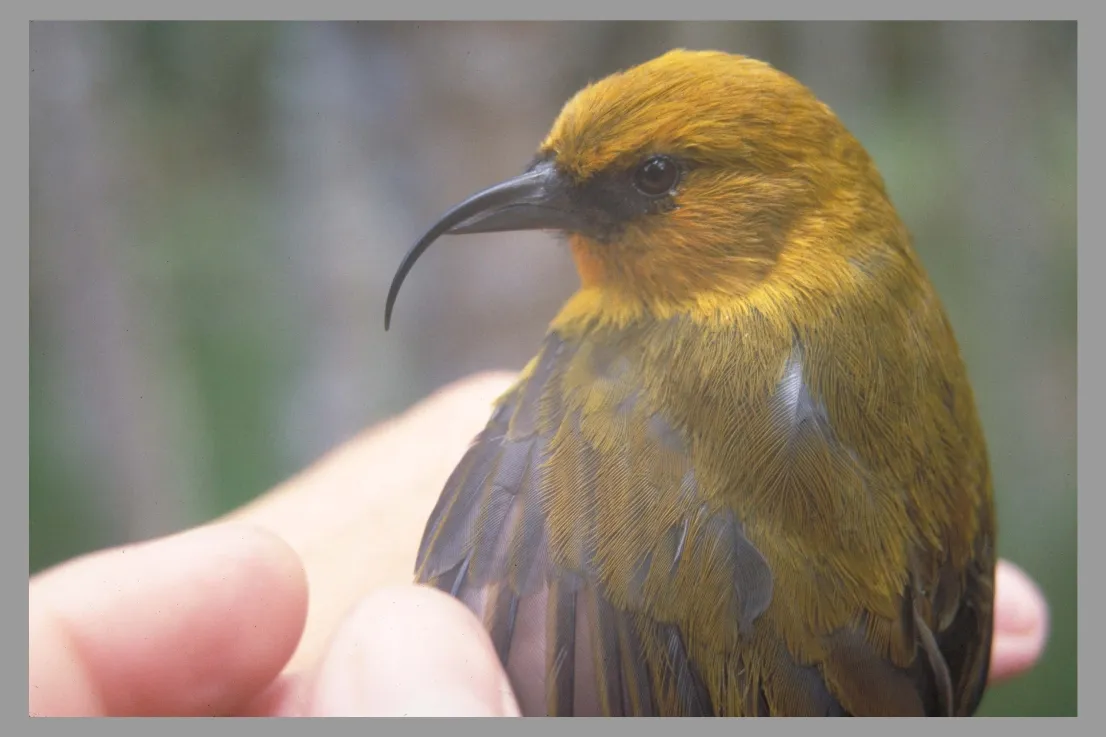
Three of Hawaii's rarest birds have been detected at lower elevations along the volcanic summits for the first time in 30 years, a sign the endangered species may be holding their own against introduced diseases and climate change, scientists say.
Avian malaria and pox virus, two introduced mosquito-borne pathogens, limit the habitat of many susceptible Hawaiian birds to areas above the range of mosquitoes. Scientists are concerned warming conditions could allow mosquitoes to expand their range, thus hitting birds even harder and driving more of the endangered birds to extinction.
Scientists with the U.S. Fish and Wildlife Service and U.S. Geological Survey rediscovered the birds as part of a project looking at the potential impact of climate change on bird diseases.
All of the rediscovered species, which live in the Hakalau Forest National Wildlife Refuge on the big island of Hawaii, are thought to be vulnerable to mosquito-transmitted diseases, limiting their distribution to the cooler, higher elevations of the refuge where mosquitoes are less likely to thrive. Observations of the birds significantly expanded their known range.
Scientists heard the songs of the Hawaii Creeper and Hawaii 'Akepa at 4,200 feet (1,280 meters) above sea level, very near where they were last seen in the 1970s. One endangered 'Akiap?l?'au was also seen at the same elevation, 1,000 feet (305 m) lower than detected 30 years ago.
Scientists don't know what's allowed the birds to survive at lower elevations than expected, although they are currently conducting research to find out.
"Hawaii's native birds face multiple threats from habitat destruction, invasive species, introduced diseases and climate change, with many already having been driven to extinction," said U.S. Geological Survey director Marcia McNutt in a statement. "The observation of three endangered species possibly expanding their range in a wildlife refuge gives us hope that with some care, the road to extinction need not be a one-way street."
Get the world’s most fascinating discoveries delivered straight to your inbox.
Follow OurAmazingPlanet for the latest in Earth science and exploration news on Twitter @OAPlanet. We're also on Facebook and Google+.
