A painstakingly planned photo expedition to see the annular solar eclipse paid off spectacularly for two veteran astrophotographers.
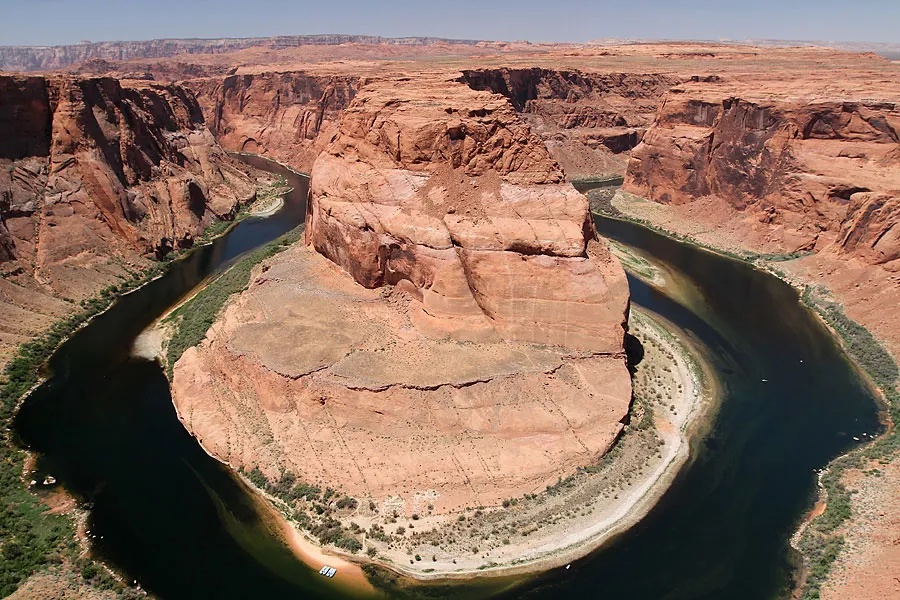
Imelda Joson and Edwin Aguirre, based in Boston, traveled to the Horseshoe Bend Overlook at Page in northern Arizona to view and photograph the annular solar eclipse that was visible across much of the western half of the country yesterday (May 20).
Imelda Joson and Edwin Aguirre recorded the May 20th annular eclipse of the Sun in from Page, Ariz., using a solar-filtered Takahashi FC-60 telescope and a Canon EOS 20D digital SLR camera.
(Image credit: Imelda Joson and Edwin Aguirre)
"The sky was perfectly clear in Page throughout the day," Joson and Aguirre wrote in a statement. The pair had analyzed weather statistics across the eclipse's path, as well as the expected duration of the eclipse at different spots to arrive at their final pick for a viewing spot.
At Horseshoe Bend, "the Colorado River makes a spectacular 270-degree turn in the Glen Canyon," Joson and Aguirre wrote. The spot is at an elevation of 4,300 feet (1,300 meters) above sea level.
Imelda Joson endured the desert heat to document the Moon
(Image credit: Edwin Aguirre)
The spot they picked was less than half a mile from the central line of the eclipse track, where the full eclipse was visible, and more than 600 amateur astronomers and tourists gathered at the spot. They "were able to witness a perfectly concentric solar 'annulus,' or ring, during mid-eclipse at 6:35 p.m. local time, with the sun about 10 degrees high in the northwestern sky," the pair said.
Other parts of the country saw a partial eclipse. The eclipse was first visible in East Asia before crossing the northern Pacific Ocean.
Annular eclipses only occur when the moon is at a point in its orbit that is too far from Earth to completely block the sun's disk. The result is a ringlike, or annulus, effect.
Sign up for the Live Science daily newsletter now
Get the world’s most fascinating discoveries delivered straight to your inbox.
Edwin Aguirre imaged the annular eclipse at hydrogen-alpha wavelength using a 60-millimeter double-stack-filtered Coronado SolarMax II hydrogen-alpha telescope, a 2X Barlow lens, and a Canon EOS 7D DSLR camera.
(Image credit: Imelda Joson)
Several national parks held eclipse-viewing events, and scientists from NASA's Lunar Science Institute at the Ames Research Center in Moffett Field, Calif., ventured to Grand Canyon National Park in Arizona to witness the eclipse and offer free information sessions to park visitors.
For the science geek in everyone, Live Science offers a fascinating window into the natural and technological world, delivering comprehensive and compelling news and analysis on everything from dinosaur discoveries, archaeological finds and amazing animals to health, innovation and wearable technology. We aim to empower and inspire our readers with the tools needed to understand the world and appreciate its everyday awe.