














Fiber-Optic Cable Across Pacific Could Aid Tsunami Warning

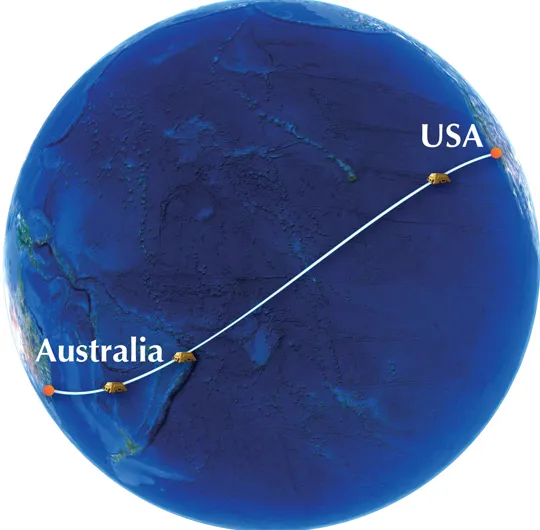
Scientists, engineers and telecommunications officials are in the early planning stages for a seafloor fiber-optic cable that would span the Pacific Ocean, and could transmit unprecedented and vital information on everything from ocean temperatures to tsunamis to people back on shore.
The team plans to equip the cable with sensitive sensors that could advance scientists' ability to observe and study ocean processes and deep Earth geodynamics, and provide early alerts for potential disasters.
The fiber-optic cable is capable of transmitting data at a maximum of 40 gigabits per second from deep-sea locations. For comparison, the entire print collection of the Library of Congress could be transmitted over the link in slightly more than 30 minutes.
"It provides us with a whole new world of capability," said John Orcutt, a distinguished professor of geophysics at the Scripps Institution of Oceanography in La Jolla, Calif., and one of the leaders of the project.
"More than 70 percent of the world is water and we need to understand much more of it," he said in a statement.
The initial project is envisioned to focus along a cable route spanning 8,105 miles (12,950 kilometers) from Sydney to Auckland, and then on across the Pacific Ocean to Los Angeles.
Initial efforts are exploring the use of seafloor seismometers, pressure gauges and temperature sensors for hazard warning and mitigation. As funding develops, sensors could be installed on future cables about 47 miles (75 km) apart.
Get the world’s most fascinating discoveries delivered straight to your inbox.
The sensors could allow scientists to measure the size and direction of tsunamis propagating across the ocean more precisely, and to alert disaster management officials and first responders more quickly.
In addition to seismometers and pressure gauges, the scientific ports along the cable line could eventually include a comprehensive suite of sensors, including climate instruments to measure ocean warming.
Follow OurAmazingPlanet for the latest in Earth science and exploration news on Twitter @OAPlanet and on Facebook.
