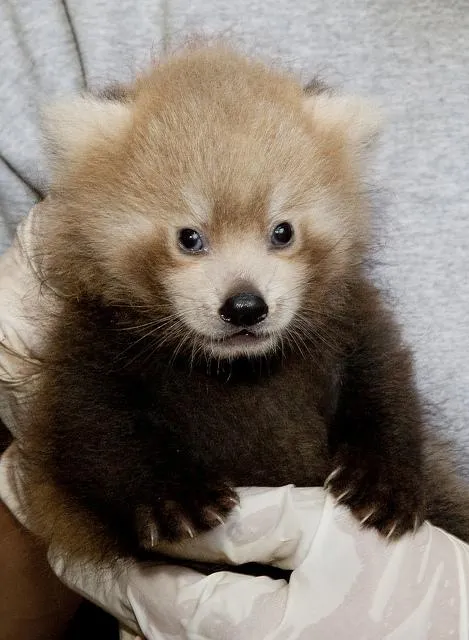
Newborns: Two red panda cubs, born to Shama and Tate, at the Smithsonian's National Zoo.
(Image credit: Juan Rodriguez, Smithsonian's National Zoo.)
Early that morning, Shama, a pregnant red panda, didn't respond to keepers' calls, the first sign that she might be caring for cubs. A slight squeal from her den confirmed she had indeed given birth.
For seven days, zoo staff left the mother alone to bond with her young, then conducted a one-minute check-in on the fluffy little pandas, confirming there were indeed two cubs in the nesting box.
All four cubs have now opened their eyes, and keepers have confirmed that all are female.
To avoid disturbing the cubs and their mothers, zoo staff have adopted stealthy methods to monitor the little pandas . When handling the cubs to weigh them and conduct medical checks, keepers wear gloves that have been rubbed with material from the pandas' nests and have been scented with a special fragrance the panda mothers' feces to cover up the scent of humans.
Sign up for the Live Science daily newsletter now
Get the world’s most fascinating discoveries delivered straight to your inbox.
Keepers hold the panda cubs wearing special poo-scented gloves.
All four newborns are steadily gaining weight and appear healthy.
Red pandas, sometimes called firefoxes for their reddish fur, bear a strong resemblance to raccoons, and feed on bamboo leaves, berries, flowers, small plant leaves and even bird eggs in temperate forests in western China, the Himalayas and Myanmar.
The species is listed as vulnerable, according to the International Union for the Conservation of Nature. There are roughly 2,500 adult red pandas worldwide.
For the science geek in everyone, Live Science offers a fascinating window into the natural and technological world, delivering comprehensive and compelling news and analysis on everything from dinosaur discoveries, archaeological finds and amazing animals to health, innovation and wearable technology. We aim to empower and inspire our readers with the tools needed to understand the world and appreciate its everyday awe.