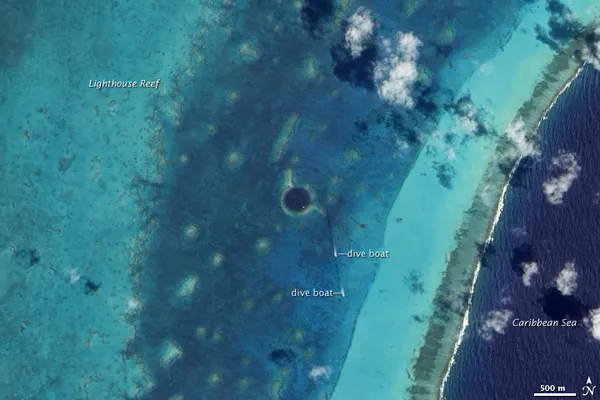
Surrounded by darker, deeper ocean waters, coral atolls often glow in vibrant hues of turquoise, teal, peacock blue, or aquamarine.
Belize's Lighthouse Reef Atoll fits this description, with its shallow waters covering light-colored coral: the combination of water and pale corals creates varying shades of blue-green. Within this small sea of light colors, however, lies a giant circle of deep blue. Roughly 300 meters (1,000 feet) across and 125 meters (400 feet) deep, the feature is known as the Great Blue Hole, according to a European Space Agency statement.
The Advanced Land Imager (ALI) on NASA's Earth Observing-1 satellite captured this image of the Great Blue Hole and Lighthouse Reef in the Caribbean Sea on March 24, 2009. The Great Blue Hole appears at the center of the image, surrounded by a ring of lighter color caused by elevated coral.
(Image credit: NASA image created by Jesse Allen.)
Boats traveling to and from the Great Blue Hole attest to its popularity as a diving site. Besides modern-day marine life, this vertical cave contains remnants from its days above water. When much of Earth's water was sequestered in glaciers, global sea level was lower. During this time, stalactites or dripstones formed inside this cave, and those rocks are preserved underwater today.
Believed to be the world's largest feature of its kind, the Great Blue Hole is part of the larger Belize Barrier Reef Reserve System, a World Heritage site of the United Nations Educational, Scientific and Cultural Organization (UNESCO).
For the science geek in everyone, Live Science offers a fascinating window into the natural and technological world, delivering comprehensive and compelling news and analysis on everything from dinosaur discoveries, archaeological finds and amazing animals to health, innovation and wearable technology. We aim to empower and inspire our readers with the tools needed to understand the world and appreciate its everyday awe.