













Tiny Skull Sheds Light on Strange Dinosaur Diets
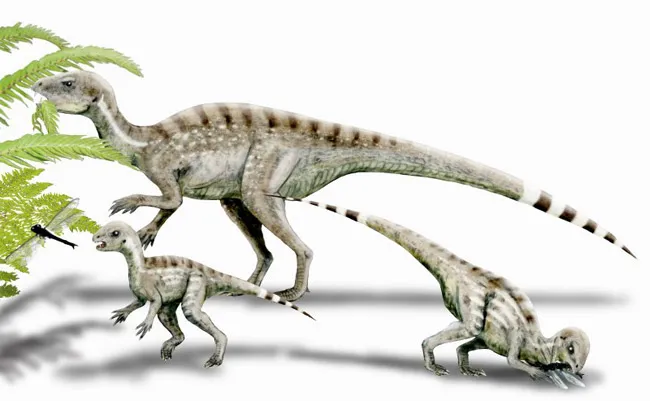
A juvenile dinosaur weighing less than two sticks of butter was a toothy hodgepodge equipped with fang-like canines to tear into small mammals, reptiles and insects, as well as flat molars for plant munching.
Researchers recently found the skull of this dinosaur called Heterodontosaurus tucki in a drawer at the Iziko South African Museum. Now considered one of the smallest dinosaur skulls ever discovered, measuring less than two inches (45 millimeters) in length, the noggin is helping scientists to figure out how and when meat-eating dinosaurs evolved into plant-eaters.
"It's likely that all dinosaurs evolved from carnivorous ancestors," said researcher Laura Porro, a post-doctoral student at the University of Chicago. "Since heterodontosaurs are among the earliest dinosaurs adapted to eating plants, they may represent a transition phase between meat-eating ancestors and more sophisticated, fully-herbivorous descendents."
(Heterodontosaurus was one of the earliest ornithischian dinosaurs, which were bird-hipped herbivores whose members included duck-billed and horned dinosaurs.)
In addition, the juvenile skull will shed light on the development of the heterodontosaurs from youngster to mature adult.
"This discovery is important because for the first time we can examine how Heterodontosaurus changed as it grew," said lead researcher Richard Butler of the Natural History Museum in London. "The juvenile Heterodontosaurus had relatively large eyes and a short snout when compared to an adult, similar to the differences we see between puppies and fully-grown dogs."
The discovery is detailed in the fall issue of the Journal of Vertebrate Paleontology.
Get the world’s most fascinating discoveries delivered straight to your inbox.
Heterodontosaurus lived about 190 million years ago during the Early Jurassic Period in southern Africa. While the juvenile was a half-pint, adult heterodontosaurs were turkey-sized animals, reaching just over three feet (just under one meter) in length and weighing around five to six pounds (2 kg to 3 kg).
The heterodontosaurs were equipped with a wide variety of teeth. Fang-like canines graced the fronts of their jaws, while molar-like grinding teeth took up residence in the back of the mouth.
This bizarre suite of teeth has led to debate over heterodontosaurs' diets. Some scientists thought heterodontosaurs were omnivores, relying on their differently-shaped teeth to eat both plants and small animals. Others contended that heterodontosaurs were herbivores who ate only plants and that the canines were sexually dimorphic — present only in males. In the latter scenario, the fangs would have served as weapons by rival males in disputes over mates and territories.
Butler, Porro and their colleagues found the juvenile already had a fully-developed set of canines.
"The fact that canines are present at such an early stage of growth strongly suggests that this is not a sexually dimorphic character, because such characters tend to appear later in life," Butler said.
Rather, the researchers suspect the canines were used as defensive weapons against predators, or for ripping into occasional small animals. In this case, heterodontosaurs mainly chomped on plants and so would be referred to as "occasional omnivores."
The research was funded by the Royal Society, Cambridge University and the Gates Cambridge Trust.
- Image Gallery: Dinosaur Fossils
- A Brief History of Dinosaurs
- All About Dinosaurs
Jeanna Bryner is managing editor of Scientific American. Previously she was editor in chief of Live Science and, prior to that, an editor at Scholastic's Science World magazine. Bryner has an English degree from Salisbury University, a master's degree in biogeochemistry and environmental sciences from the University of Maryland and a graduate science journalism degree from New York University. She has worked as a biologist in Florida, where she monitored wetlands and did field surveys for endangered species, including the gorgeous Florida Scrub Jay. She also received an ocean sciences journalism fellowship from the Woods Hole Oceanographic Institution. She is a firm believer that science is for everyone and that just about everything can be viewed through the lens of science.