













Next Dinosaur Rock Star Chosen in Canada

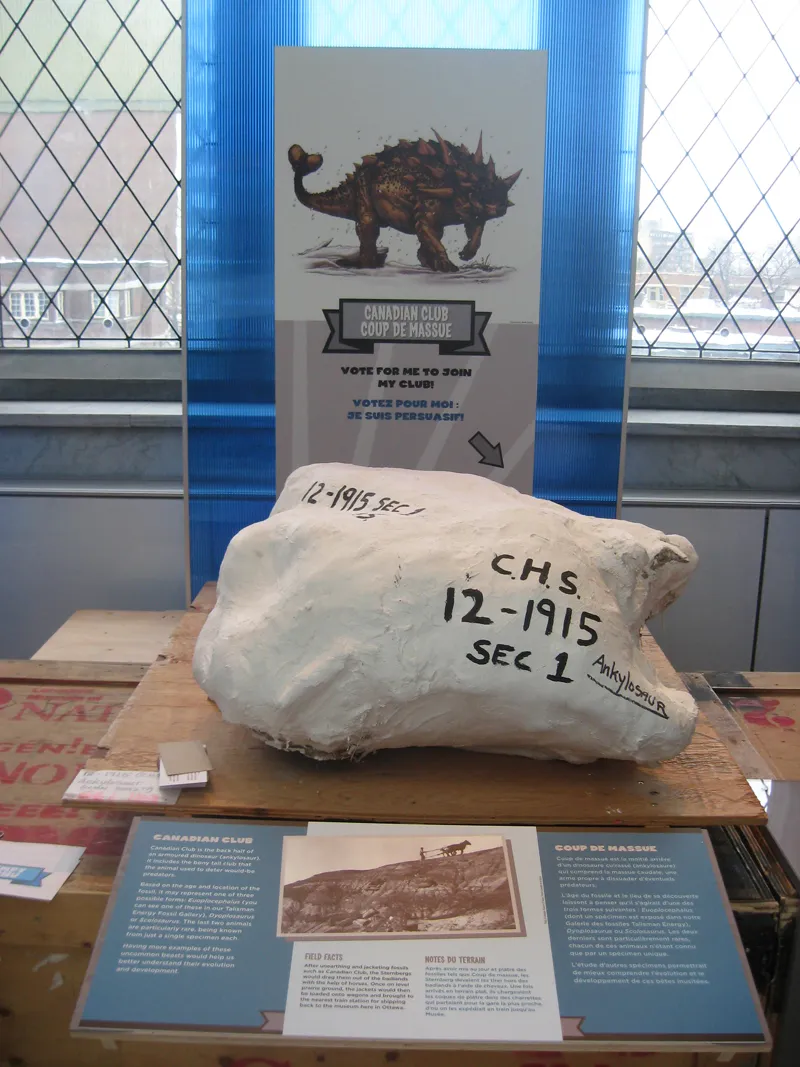
A spiky dinosaur took the top vote in a Canadian "Dino Idol" that asked visitors to one museum to select which fossil among five specimens that they wanted to see unwrapped from its protective packet.
"Canadian Club," an ankylosaur, took 36 percent of the votes cast. Its tally was 605 more votes than the second-place winner, which was part of a dinosaur mouth known as "Mystery Jaw."
Before voting, visitors to the Canadian Museum of Nature in the past month could view the fossils in their "jackets" of burlap, plaster and surrounding rock material.
"Our visitors were clearly drawn to Canadian Club, although each candidate was selected to provide something interesting to uncover," said Jordan Mallon, a palaeontologist at the museum, in Ottawa.
"The field notes from when Canadian Club was collected say the fossil includes the hips, tail and club of an ankylosaur. It's unusual to find these parts articulated or attached, so if that's the case it could provide more information about this dinosaur's anatomy." [Gallery: Dinosaurs Locked in Rock]
Each of the five specimens was collected between 1912 and 1924 by a famous Canadian fossil collector family, the Sternbergs. The Sternbergs retrieved Canadian Club in 1915 from an area now known as Dinosaur Provincial Park in Alberta, about 112 miles (180 kilometers) east of Calgary.
The fossil weighs in at 661 pounds (300 kilograms). Canadian Club's jacket will be opened April 8.
Get the world’s most fascinating discoveries delivered straight to your inbox.
"The preparation may be challenging because the fossil is embedded in ironstone," the museum stated.
"Removing this hard substrate while preserving the more delicate fossil remains is likened to extracting an eggshell out of concrete."
Mallon said he is hoping to see scutes, or bony plates or scales that were on the skin of ankylosaurs. The scutes could have acted as a shield against predators to the plant-eating animal, he said.
The museum will share the unwrapping through several social media channels and will also post videos and blog updates as the work progresses.
Full results of the votes were as follows:
- Canadian Club (36 percent of votes): The hips, tail and bony club of an ankylosaur, possibly from the species Euoplocephalus tutus, collected in 1915.
- Mystery Jaw (25 percent): A mystery jaw from a tyrannosaurid, a carnivorous dinosaur, collected in 1914 that may belong to earlier cousins of Tyrannosaurus rex: Gorgosaurus libratus or Daspletosaurus torosus.
- Stumpy (18 percent): The skull of a horned dinosaur, possibly the rare Arrhinoceratops, which was collected in 1924.
- Regal Ed (11 percent): The skeleton of a duck-billed dinosaur called Edmontosaurus regalis.
- Headrosaur (10 percent): The skull of a hadrosaur, or a duck-billed dinosaur, found in 1914. The rest of its body likely washed away long ago.
Follow Elizabeth Howell @howellspace. Follow us @livescience, Facebook & Google+. Original article on LiveScience.com.

Elizabeth Howell was staff reporter at Space.com between 2022 and 2024 and a regular contributor to Live Science and Space.com between 2012 and 2022. Elizabeth's reporting includes multiple exclusives with the White House, speaking several times with the International Space Station, witnessing five human spaceflight launches on two continents, flying parabolic, working inside a spacesuit, and participating in a simulated Mars mission. Her latest book, "Why Am I Taller?" (ECW Press, 2022) is co-written with astronaut Dave Williams.