
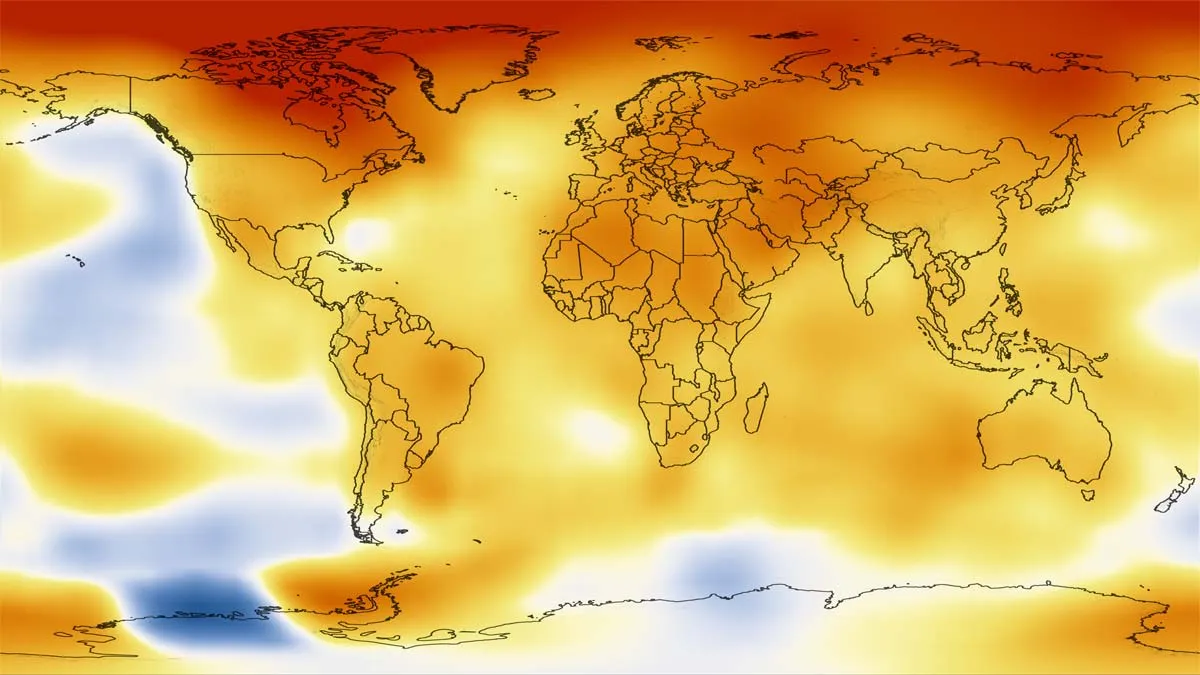
Last year was the ninth hottest year for the globe since 1880, according to new data released by NASA and the National Oceanic and Atmospheric Association (NOAA) today (Jan. 15).
Of the nine hottest years on record, eight have come since the year 2000, with 2005 and 2010 sharing the dubious title of hottest year on record. The new data reveal the alarming, long-term trend of global warming caused by human emissions of carbon dioxide and other greenhouse gases, climate scientists said.
"The planet is out of balance, there's more energy coming in than going out," said James Hansen, director of NASA's Goddard Institute for Space Studies, during the press conference. "So therefore we can predict with confidence that the next decade is going to be warmer than the last one."
Article continues belowTo calculate the global surface temperature, scientists at the NASA's Goddard Institute for Space Studies in New York collect temperature data from 1,000 weather stations around the world and combine that with sea-surface temperatures derived from satellite imagery and data from Antarctic research stations. The global surface temperature last year was about 58.3 degrees Fahrenheit (14.6 Celsius), about 1 degree Fahrenheit (0.6 Celsius) above the average from 1951 to 1980.
While the planet overall experienced a warm year, the continental United States faced a particularly hot year that blew all previous records away. The average temperature, about 55.3 degrees Fahrenheit (12.9 Celsius) was 3.25 degrees Fahrenheight (1.8 degrees Celsius) higher than the average from 1951 to 1980. [The 7 Hottest Climate Change Stories of 2012]
"We've broken the record by more than one degree, that is quite impressive," said Thomas R. Karl, director, NOAA's National Climatic Data Center, Asheville, N.C., during a press briefing today. "It literally smashed the record."
The incredibly warm spring and summer in the United States led to early greening of vegetation, followed by extreme drought conditions that are still going on, Karl said in the press conference.
Get the world’s most fascinating discoveries delivered straight to your inbox.
The findings emphasize that skyrocketing emissions of greenhouse gases such as carbon dioxide and methane are warming the planet. These gases trap heat in the atmosphere rather than letting it escape back into space.
The amount of carbon dioxide in the atmosphere has risen precipitously since the advent of the industrial revolution: In 1880, the atmospheric carbon dioxide concentration was about 285 parts per million, while today, it is more than 385 parts per million, according to NOAA's data. Though that carbon dioxide can come from natural sources, most of it comes from the burning of fossil fuels to power modern society.
Natural variations in weather mean the spike in atmospheric carbon dioxide may not translate into a year-over-year, consistent increase in the planet's temperature, but each successive decade will probably be warmer.
But one trend that will most probably occur next year is 2012's stunning loss of sea ice in the Arctic this summer and fall, Karl said. That can have global implications because the Arctic can affect sea levels and weather patterns across the planet.
Follow LiveScience on Twitter @livescience. We're also on Facebook & Google+.

Tia is the editor-in-chief (premium) and was formerly managing editor and senior writer for Live Science. Her work has appeared in Scientific American, Wired.com, Science News and other outlets. She holds a master's degree in bioengineering from the University of Washington, a graduate certificate in science writing from UC Santa Cruz and a bachelor's degree in mechanical engineering from the University of Texas at Austin. Tia was part of a team at the Milwaukee Journal Sentinel that published the Empty Cradles series on preterm births, which won multiple awards, including the 2012 Casey Medal for Meritorious Journalism.