













Hawaiian Island Dissolving From Within

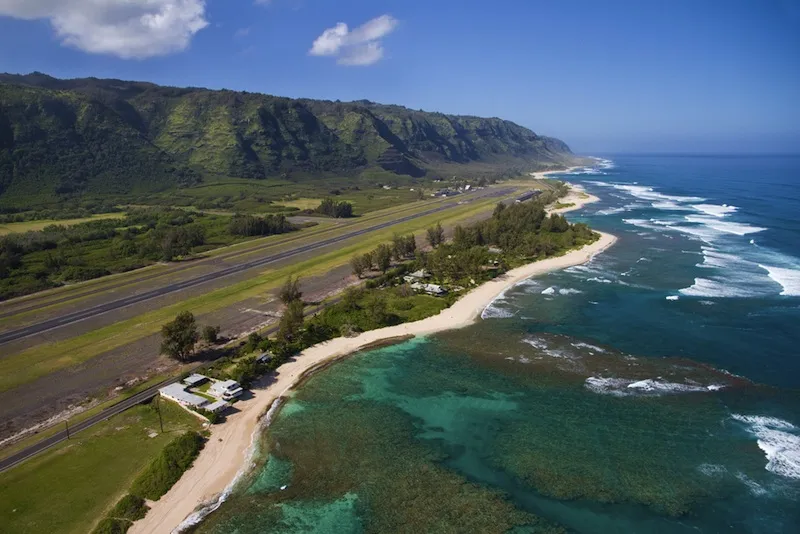
Plan your island getaway now: In time, the mountainous tropical paradise of Oahu will erode, according to new research, with the biggest losses coming from within the island itself.
To be accurate, you do have some time to book that vacation before Hawaii's Oahu flattens from an island into a low-lying seamount. Researchers writing in the upcoming February 15 issue of the journal Geochimica et Cosmochimica Acta estimate that the volcanic island will continue to grow, thanks to plate tectonics, for another 75,000 to 1.75 million years. After that, however, the forces working to eat away at Oahu from the inside out will begin to triumph.
Researchers at Brigham Young University in Utah investigated the forces that add and subtract material from Oahu. The island offers an ideal place to conduct such a study, the researchers said, as it consists of one kind of rock that is exposed to very different levels of precipitation. Various regions in Oahu can record between 2 and 23 feet (0.6 to 7 meters) of precipitation a year, depending on the local climate. [Gallery: One-of-a-Kind Places on Earth]
The researchers measured solids dissolved in both surface and groundwater from 45 streams and 30 springs and wells around the island, adding those new measurements to previously reported data, for a total of 170 water samples scattered across Oahu.
Using that data, scientists calculated the mass Oahu loses each year. Although one might expect rain to carry away most of the soil in such a wet climate, underground freshwater springs actually removed the bulk of the mineral material from Oahu, the researchers found.
"More material is dissolving from those islands than what is being carried off through erosion," study researcher Steve Nelson, a Brigham Young University geologist, said in a statement.
In fact, groundwater carried between three and 12 times as much dissolved solids compared to surface water, the researchers report.
Get the world’s most fascinating discoveries delivered straight to your inbox.
Oahu is made up of the remnants of two collapsed shield volcanoes, the kind known for burping out thick, oozy lava that hardens into new land. One volcano, Waianae, was active from about 4 to 2.6 million years ago; the other, Koolau, developed later.
Today, Oahu grows not because of volcanism, but from geologic uplift. As the younger Hawaiian Islands push the Pacific tectonic plate downward, nearby Oahu "pops up," as if on a seesaw. That uplift pushes Oahu's landforms upward at a rate of 0.2 feet (0.06 m) per thousand years, enough (for now) to compensate for the losses caused by groundwater carrying away the island's mass.
Researchers hope that the same methods they used on Oahu can help clarify how other tropical islands change in response to different climate conditions.
Follow Stephanie Pappas on Twitter @sipappas or LiveScience @livescience. We're also on Facebook & Google+.

Stephanie Pappas is a contributing writer for Live Science, covering topics ranging from geoscience to archaeology to the human brain and behavior. She was previously a senior writer for Live Science but is now a freelancer based in Denver, Colorado, and regularly contributes to Scientific American and The Monitor, the monthly magazine of the American Psychological Association. Stephanie received a bachelor's degree in psychology from the University of South Carolina and a graduate certificate in science communication from the University of California, Santa Cruz.