














Nearby Galaxy Convicted of Star Theft

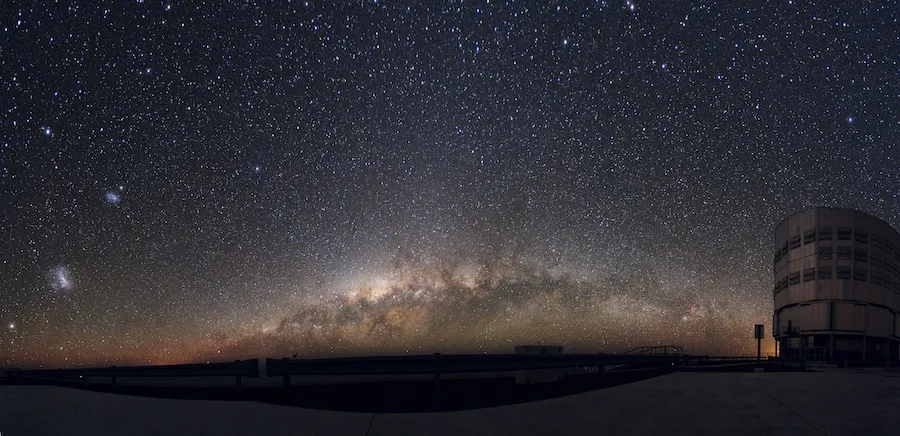
One of the closest galaxies to the Milky Way is a star thief, astronomers say.
New simulations suggest that the Large Magellanic Cloud (LMC) snatched a stream of stars from its neighbor, the Small Magellanic Cloud (SMC), when the two galaxies collided 300 million years ago.
Astronomers uncovered the galactic crime while searching the LMC for evidence of massive compact halo objects, or MACHOs. Scientists don't fully understand the nature of MACHOs; the researchers were investigating whether these objects could be a major component of dark matter in the universe.
For their investigation, astronomers turned to gravitational microlensing, since dark matter cannot be seen directly. With this technique, scientists watch what happens when a massive body lies in front of a farther object as viewed from Earth. The massive body bends and magnifies the light from the farther object like a lens, and the characteristics of the resulting light can provide information about the body causing the warping.
But the number of microlensing events recorded by various teams was too small to account for dark matter, ruling out the possibility that dark matter is contained in MACHOs, the researchers said. However, there were more microlensing events than expected based on the known number of stars in the Milky Way.
Astronomers said the most likely explanation for these events was an unseen string of stars stolen from the SMC by the LMC during a galactic collision. The mass of foreground stars in the LMC is thought to be causing the gravitational lensing of the stolen stars, the researchers said.
"Instead of MACHOs, a trail of stars removed from the SMC is responsible for the microlensing events. You could say we discovered a crime of galactic proportions," Avi Loeb of the Harvard-Smithsonian Center for Astrophysics said in an Oct. 29 statement.
Get the world’s most fascinating discoveries delivered straight to your inbox.
"By reconstructing the scene, we found that the LMC and SMC collided violently hundreds of millions of years ago. That's when the LMC stripped out the lensed stars," Loeb added.
Researchers are now searching for further evidence of these stolen stars in a bridge of gas that connects the Magellanic Clouds. The study appears online in the Monthly Notices of the Royal Astronomical Society.
This story was provided by SPACE.com, a sister site to LiveScience. Follow SPACE.com on Twitter @Spacedotcom.We're also on Facebook and Google+.
