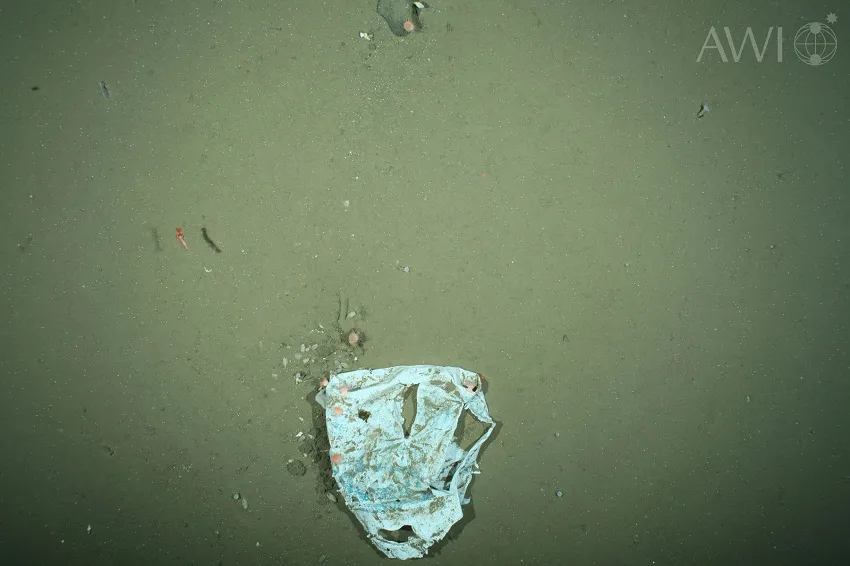
Plastic bags strangling sea sponges. Beer bottles colonized by sea lilies. Such images of ocean pollution aren't usually associated with the remote, icy waters of the Arctic, but snapshots of the seafloor suggest the northern region is becoming increasingly littered with plastic.
Scientists regularly drag an underwater camera just above the sea bed during expeditions to HAUSGARTEN, a deep-sea Arctic observatory in the eastern Fram Strait, between Greenland and Norway's Svalbard archipelago. The photos it takes are usually analyzed for the presence of sea cucumbers, fish, shrimp and other large inhabitants, which could indicate changes in Arctic biodiversity. But the camera sometimes catches unwelcome guests: plastic bags and other trash resting on the seafloor.
"The study was prompted by a gut feeling," said researcher Melanie Bergmann in a statement. "When looking through our images I got the impression that plastic bags and other litter on the seafloor were seen more frequently in photos from 2011 than in those dating back to earlier years. For this reason I decided to go systematically through all photos from 2002, 2004, 2007, 2008 and 2011."
Bergmann, a biologist with the Alfred Wegener Institute for Polar and Marine Research, found waste in 1 percent of the pictures from 2002 and 2 percent in the 2011 images, marking a twofold increase over the decade. The sharpest rise in garbage occurred between 2007 and 2011, according to the study of more than 2,000 images.
This graphic shows the Ocean Floor Observation System (OFOS) at work. It is towed at a water depth of about 8200 feet (2,500 meters), 5 feet (1.5 meters) above the sea bed, and takes a photograph every 30 seconds.
(Image credit: Normen Lochthofen, Alfred Wegener Institute)
Two percent is a high figure for a region thought to be one of the most secluded on the planet, the researchers said. Bergmann pointed out that they recorded more garbage in their study than was observed in a deep-sea canyon not far from the industrialized Portuguese capital Lisbon.
Almost 70 percent of the litter in the pictures was in contact with deep-sea organisms, the researchers said, warning that garbage can injure creatures like sea sponges and impair their ability to breathe and absorb food. Moreover, chemicals in plastic can have toxic effects and alter gas exchange on the seafloor.
Plastic even poses a threat when it's no longer visible to the naked eye. Earlier studies have demonstrated how plastic that has broken down into microscopic particles can soak up pollutants such as polychlorinated biphenyls, or PCBs. When ingested by tiny ocean animals, these toxin-loaded plastic particles contaminate the food chain.
Sign up for the Live Science daily newsletter now
Get the world’s most fascinating discoveries delivered straight to your inbox.
Map of the Alfred Wegener Institute deep-sea long-term observatory HAUSGARTEN.
(Image credit: Ingo Schewe, Alfred Wegener Institute)
On a positive note, waste could provide a good surface for some organisms to latch on to and flourish, but researchers are not sure how this would affect the deep-sea composition of species and biodiversity in the region.
The scientists, whose study appears online this month in the journal Marine Pollution Bulletin, pointed to melting sea ice and increasing ship traffic in the Arctic as possible causes for the rise in plastic.
"The Arctic sea ice cover normally acts as a natural barrier, preventing wind blowing waste from land out onto the sea, and blocking the path of most ships," Bergmann explained. "Ship traffic has increased enormously since the ice cover has been continuously shrinking and getting thinner. We are now seeing three times the number of private yachts and up to 36 times more fishing vessels in the waters surrounding Spitsbergen compared to pre-2007 times."
Megan has been writing for Live Science and Space.com since 2012. Her interests range from archaeology to space exploration, and she has a bachelor's degree in English and art history from New York University. Megan spent two years as a reporter on the national desk at NewsCore. She has watched dinosaur auctions, witnessed rocket launches, licked ancient pottery sherds in Cyprus and flown in zero gravity. Follow her on Twitter and Google+.