














Mountain Lions Migrating West to California

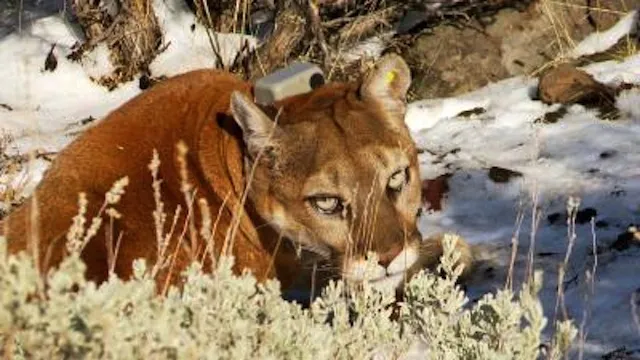
Mountain lions from southern and eastern Nevada are moving west to California, according to a genetic study of nearly 740 big cats.
The seven-year study tracked cougars, as mountain lions are also known, in both states to discover which areas in the region serve as "sinks" (habitat that animals move to at a greater rate than they leave) and "sources" (areas that animals leave to live elsewhere).
Because mountain lions are hunted in Nevada, leaving fewer cats and, therefore, more available land for migration, the researchers expected to find evidence of the animals traveling from California into Nevada. Instead, more lions moved west from central Nevada to the Sierra Nevada Mountains in eastern California, the study found.
"It was opposite than what we expected because lions are hunted in Nevada, and when territories are made vacant from hunting, then lions would move eastward because they are attracted to open territories," said lead author Alyson Andreasen, a doctoral student in ecology at the University of Nevada, Reno.
Overall, the greatest source of migrating animals was southern Nevada, home of the Desert National Wildlife Refuge and the Nevada Test Site. Together, they provide thousands of miles of land protected from hunting. Mostly, lions moved in a north and south direction following the orientation of the Great Basin's many mountain ranges.
"It's not a really high rate of interchange of individuals and genetics, but we do have evidence that individuals are moving," said Jon Beckmann, study co-author and a conservation ecologist with the Wildlife Conservation Society. "The next step is to dig a little deeper and define what that rate really is and how many individuals there are per year," Beckmann told OurAmazingPlanet.
The researchers tested DNA from 739 tissue samples provided by the Nevada Department of Wildlife and the California Department of Fish & Game. The animals were live-captured for research, harvested by hunters (in Nevada only), harvested for depredation, or had died because of other causes. The results showed only that mountain lions were traveling across geographic regions, not how often, or how many individuals, or when. The study's goal was determining the movement of mountain lions on a landscape scale, which is difficult to do by collaring, Andreasen said.
Get the world’s most fascinating discoveries delivered straight to your inbox.
The researchers are now tracking individual animals with radio collars to better understand migration between different populations in Nevada and California.
It's important for management and conservationto know population structure and how those populations interact with each other," Andreasen told OurAmazingPlanet.
Nevada is home to about 3,000 cougars, while California has 4,000 to 6,000 cats prowling its mountains and shores.
The findings were detailed online in the August 2012 early edition of the journal Molecular Ecology.
Reach Becky Oskin at [email protected]. Follow her on Twitter @beckyoskin. Follow OurAmazingPlanet on Twitter @OAPlanet. We're also on Facebook and Google+.
