














Southwestern United States Spied from Space

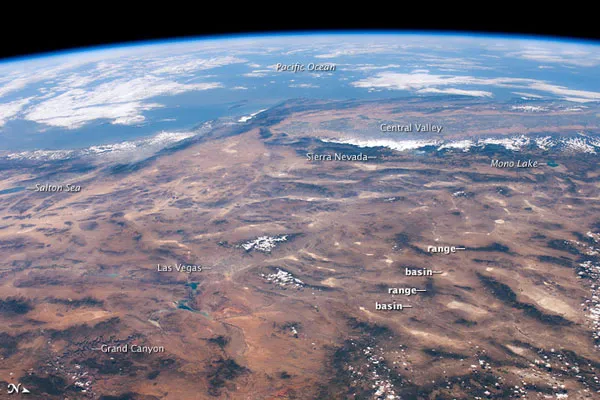
This panoramic view of the southwestern United States and Pacific Ocean was taken by an astronaut onboard the International Space Station (ISS).
While most unmanned satellites view the Earth from a nadir perspective collecting data while looking "straight down" astronauts on the ISS can acquire imagery at a wide range of viewing angles using handheld digital cameras. The spacecraft was located directly above northwestern Arizona, approximately 160 miles (260 kilometers) to the east-southeast, when this picture was taken.
The image, taken on Sept. 9, includes parts of Arizona, Nevada, Utah and California, as well the coastline of Baja California, Mexico.
The Las Vegas metropolitan area appears as a gray region adjacent to the Spring Mountains and Sheep Range, which are both covered by clouds in this image. The Grand Canyon is visible to the east of Las Vegas, with the blue waters of Lake Mead in between. It is even possible to see the Mojave Desert, which stretches north from the Salton Sea to the Sierra Nevada mountain range.
The Sierra Nevada is roughly 400 miles (640 kilometers) long and forms the boundary between the Central Valley of California and the adjacent Basin and Range region. The Basin and Range is known as such because of the pattern of long linear valleys separated by parallel mountain ranges. The landscape was formed by the extension and thinning of the Earth's crust.
- Observing Earth: Amazing Views from Above
- Image Gallery: The Grand Canyon in Pictures
- 101 Amazing Earth Facts
Get the world’s most fascinating discoveries delivered straight to your inbox.
