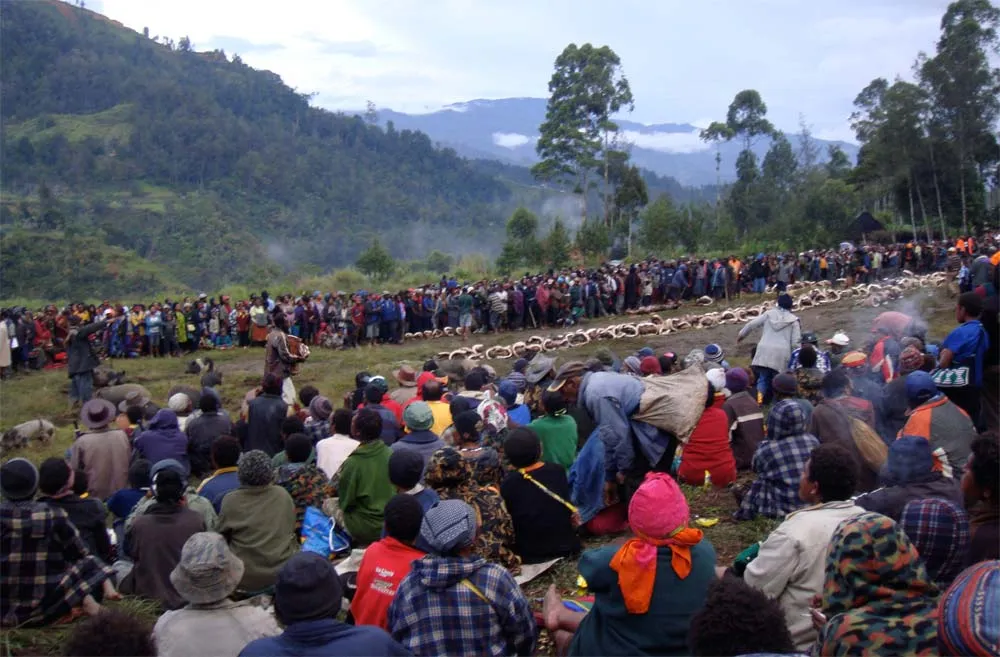
Around 1850, Enga leaders established a compensation system to quash postwar violence. In a large, public ceremony (shown here), individuals handed over live pigs and other valuables to their enemies as compensation for deaths.
The Enga people of Papua New Guinea have long been used to a culture where small-scale wars were common, short-lived and ended in peaceful relations between clans. But in 1990, the younger generation ditched their bows and arrows for shotguns and semiautomatics, and the Enga experienced 20 years of runaway violence that claimed nearly 5,000 lives.
Now, research shows that clan elders have restored peace by using their traditional tribal court system. As a result of the state-sanctioned system, relatively few wars took place in 2010 and 2011, and the death toll per war has dropped dramatically. For example, from 2006 to 2010, 74 percent of wars ended after only one to five deaths, compared with 23 percent of wars from 1991 to 1995.
The results suggest complex societies don't always evolve from simpler societies that are much more violent, as some psychologists and anthropologists contend, researchers said.
"These simple face-to-face societies have very effective means of making peace," said study leader Polly Wiessner, an anthropologist at the University of Utah. "It's when societies coalesce and are driven into larger societies, when they become no longer face-to-face, that these peace mechanisms no longer work."
Escalating wars
There are currently 400,000 to 500,000 Engas. They're divided into 110 tribes, each of which has five to 10 clans. "The clans hold a piece of land and cooperate in exchange, warfare and marriage," Wiessner told LiveScience. [Image Gallery: Faces of a Threatened Tribe]
Despite the strong inter-clan ties, Enga history has been marked by occasional wars. These eruptions of violence typically lasted a few days to a few weeks, and served to re-establish power between groups, show a clan's strength or avenge some misdeed.
Sign up for the Live Science daily newsletter now
Get the world’s most fascinating discoveries delivered straight to your inbox.
Around 1850, Enga leaders established a system of compensation to quash postwar violence. In a large, public ceremony, individuals handed over live pigs — a major form of currency — and other valuables to their enemies as compensation for deaths.
Clan of the deceased Enga people performs a traditional mock attack upon arrival to receive compensation.
(Image credit: Polly Wiessner)
These "Tee" ceremonies helped form massive exchange networks between clans and tribes. "Part of war was to keep balance between clans so exchange could flow," Wiessner explained.
Papua New Guinea came under Australian colonial rule in the 1950s. Armed administrators kept the peace and disputes were settled in the court rather than on the battlefield. Many Enga traditions ended, including the Tee exchanges.
After gaining independence in 1975, the country established a dual court system. District courts mainly served business needs, while village courts handled local matters. Local leaders were elected as magistrates to preside over the village courts. In 1982, a branch of the village court called Operation Mekim Save (OMS) arose to specifically handle tribal wars.
At the time, battles were still fought with primitive weapons. "They could have had guns, but they didn't want to wipe each other out," Wiessner said. This changed in 1990 when hotheaded youths took power from the elders. They acquired guns from businessmen and hired skilled mercenaries to help in their wars, which could last for months. The number of wars spiked, as did the deaths per war, while unprecedented razing created thousands of refugees. [10 Major Innovations that Revolutionized Combat]
Tide turns
The soldiers were able to keep up their bloody battles for many years because the public supported them, both monetarily and ideologically. But eventually, around 2005, the public got tired of the bloodshed and the hardships felt with funding the wars.
"And so the people turned to the village courts," Wiessner said. "The fighters think they're saving their own group, but when the public said they don't want this, there wasn't much the youth could do."
Wiessner, who scoured data from pre-colonial warfare, 501 recent wars and 129 court sessions, says two other factors helped turn the tide toward peace: church influence (with its Christian ideology of peace) and an effective OMS court branch. In the past, OMS was slow to react when trouble sprung up. Now, magistrates are armed with cellphones and better vehicles. And their methods seem to work.
In 2011, OMS resolved 98 percent of its cases without fines or jail time. Many of the cases ended in compensation rituals seen in the past — an exchange of pigs during a public ceremony. And just like in the past, the "restorative justice" of the tribal courts appears able to curb further clan hostilities, at least for the time being. "There are almost no wars now," Wiessner said.
The study is published today (Sept. 27) in the journal Science.
Joseph Bennington-Castro is a Hawaii-based contributing writer for Live Science and Space.com. He holds a master's degree in science journalism from New York University, and a bachelor's degree in physics from the University of Hawaii. His work covers all areas of science, from the quirky mating behaviors of different animals, to the drug and alcohol habits of ancient cultures, to new advances in solar cell technology. On a more personal note, Joseph has had a near-obsession with video games for as long as he can remember, and is probably playing a game at this very moment.