













Super Stretchy Material is Also Super Strong

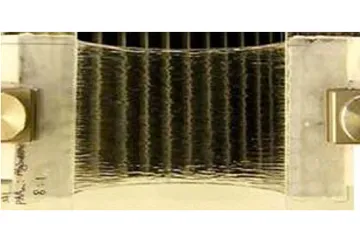
Looking for a new material that was tough, scientists developed one that also can stretch up to 20 times its original length without breaking. The new compound, a hydrogel, could someday be used as artificial cartilage, the researchers say.
A typical hydrogel (a gel whose particles are dispersed in water) can stretch only a few times its length, if that. Even natural rubber can stretch only five to six times its length.
But the new compound, made of alginate, polyacrylamide and water, proved to be far more stretchable and fracture-proof in tests. Harvard mechanical engineer Zhigang Suo said the scientists clamped it in a stretching machine and also dropped a stainless-steel ball on it.
Lab-made hydrogels are used in soft contact lenses, tissue engineering scaffolds, and drug delivery. Natural hydrogels include tofu (which can be nearly 90 percent water) and "many of our body parts," Suo said. "Cartilage, your heart, your brain can be characterized as hydrogels."
Incredibly enough, the stretchiness was just a side effect of the team's research, Suo said. "We are mainly studying this as a tough material. It happened to be very stretchable, but it really is tough."
['Super Skin' Can Stretch and Sense for Bionic Humans]
A typical hydrogel requires only 10 joules per square meter of force to break. Current contact lenses, made of a hydrogel developed in the 1960s, will break after a few hundred joules per square meter of force. Human cartilage won't tear until it's subjected to 1,000 joules per square meter.
Get the world’s most fascinating discoveries delivered straight to your inbox.
"Our material, the fracture energy goes to about 10,000," Suo said. Since the two polymers that make up the solid part of the gel are "well-known biocompatible materials," the final product may make a suitable cartilage replacement, he said.
The material can recover from being over-stretched, Suo added. If it loses elasticity after being stretched too far, heating it to 176 degrees Fahrenheit (80 degrees Celsius) will restore its stretchiness and firmness.
The research appears in the Sept. 6 issue of the journal Nature.
This story was provided by InnovationNewsDaily, a sister site to LiveScience. Follow InnovationNewsDaily on Twitter @News_Innovation. We're also on Facebook & Google+.

Rachel is a writer and editor based in Washington, D.C., who covers a range of topics for Live Science, from animals and global warming to technology and human behavior. Rachel also contributes to National Geographic News, Smithsonian Magazine and Scientific American, and she is currently a senior editor at Next City, a national urban affairs magazine. She has an English degree with a journalism concentration from Adelphi University in New York.