
















Tibetan Plateau May Be Older Than Thought

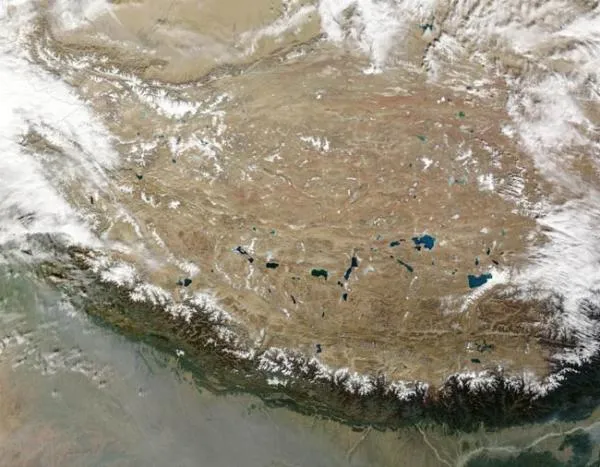
The rise of one of the highest, flattest places on Earth, the Tibetan Plateau in China's Sichuan province, began much earlier than thought, according to a new study.
"Our study suggests that high topography began to develop as early as 30 million years ago, and perhaps was present even earlier," Penn State researcher Eric Kirby said in a statement.
Most researchers believe the high mountains in eastern Tibet developed during the past 10 million to 15 million years as deep crust beneath the centralTibetan Plateau flowed to the surface, thickening the Earth's crust and causing the area to rise, Kirby said. But Kirby and his colleagues used radioactive dating to find the uplift began twice as early.
The study may help scientists better understand the complicated processes going on beneath the Himalayan Mountains and the Tibetan Plateau.
The Tibetan Plateau, with an average elevation of about 16,000 feet (4,900 meters), lies at the intersection of the most vigorous collision of continental plates on the planet, where the Indian continental plate rams into the Eurasian plate and dives beneath it.
Kirby looked at samples taken from the hanging wall of the Yingxiu-Beichuan fault, the primary fault responsible for the 2008 Wenchuan earthquake in Sichuan. The researchers used a variety of dating methods, including uranium-thorium radiometric dating, to tease out the ages of the rocks, which tells when they formed and gives clues to when they lifted. This method determines the age of a material by measuring the relative abundance of uranium-234 and thorium-230. The former decays into the latter at a known rate, and by looking at relative levels of each in a given rock layer, scientists can guess the age of the rocks.
The results of the testing, detailed Aug. 5 in the online edition of the journal Nature Geoscience, suggest rocks in the area formed about 30 million to 50 million years ago while undergoing intense erosion.After the collision of the Indian and Eurasian plates began about 50 million years ago, portions of the Tibetan plateau began to lift. As the collision progressed, material from the lithosphere (the solid outer shell of the planet) below the surface crust was pushed toward the east, toward modern-day China. But exactly how and when this happened is a matter of debate. This study suggests this process started earlier than some have assumed.
Get the world’s most fascinating discoveries delivered straight to your inbox.
"These results challenge the idea that the topographic relief along the margin of the plateau developed entirely in the Late Miocene, 5 to 10 million years ago," Kirby said. "The period of rapid erosion between 25 to 30 million years ago could only be sustained if the mountains were not only present but actively growing at this time."
Follow OurAmazingPlanet on Twitter @OAPlanet. We're also on Facebook and Google+.
