Earthquakes don't kill people. Buildings built on earthquake fault lines kill people, unless they are built specifically to handle severe earthquakes.
The twin quakes of magnitude 6.4 and 6.3 that struck Iran within 11 minutes of each other over the weekend is a devastating example of how important this understanding of geoengineering is to life on a fault zone.
The scary question for Californians and the Pacific Northwest is: Are they ready?
Let's be honest. Californians eat magnitude 4's and 5's for breakfast. And yes, the state can survive a magnitude 6.0 practically unscathed. But, ramp it up to a twin 6.4 and 6.3, and the outcome really depends on where the quakes strikes. I would expect there may be a few fatalities.
On Sept. 28, 2004, the San Andreas gave geologists exactly what they were expecting. The anticipated magnitude 6.0 Parkfield earthquake ruptured on the same fault line as it had in 1966, 1934, 1922, 1901, 1881 and 1857. The shaking lasted 10 seconds; its epicenter was at a shallow depth of five miles, about seven miles southwest of the town of Parkfield. The town reportedly has a population of 18. After the quake, everyone cheered.
Sign up for the Live Science daily newsletter now
Get the world’s most fascinating discoveries delivered straight to your inbox.
In 2003, San Simeon, Calif. experienced a magnitude 6.6 that shook about 40 buildings to the ground. In Paso Robles, the city's landmark clock tower fell from the corner of a two-story building constructed in 1892 and killed two women. They were the only casualties.
In Feb. 2001, the Nisqually earthquake of magnitude 6.8 struck along the subducting Juan de Fuca Plate under Washington. The shock rattled the state around Tacoma, Olympia and Seattle, leaving about 400 people injured, giving one person a heart attack and causing billions of dollars worth of structural damage. As the New York Times reported:
"We were very, very lucky," Gov. Gary Locke said, though the quake temporarily forced him and his family out of the governor's mansion in Olympia. "There could have been utter catastrophe had it been higher, closer to the surface," he said of the quake, which geologists said originated more than 30 miles underground.
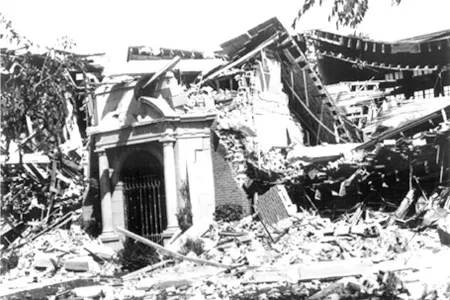
Long Beach, Calif., Earthquake March 10, 1933. Compton Junior High School, Compton, Ca. View showing extensive damage to the rear of the main school building.
Frankly, luck has nothing to do with it. Building codes are critical to saving lives. Up and down the coast since the 1930s, they have continued to get more stringent with each major earthquake disaster that has tested the current standard.
The first demand for uniform building standards, however, did not surprisingly come from the 1906 San Francisco disaster that left more than 3,000 people dead. It came nearly 30 years later.
Residents in Long Beach experienced a quake that struck at 5:54 p.m. on Friday, March 10. The temblor simply shredded about 70 schools into pieces, severely damaged 120 schools and caused minor damage to more than 300 schools. Parents were outraged. Had it struck earlier in the day the loss of life would have been horrendous. A month later, the governor signed into action the California Field Act authorizing the Division of Architecture to review, approve and supervise the construction of all public schools in the state.