













Ancient Fungus Lassoed Tiny Worms
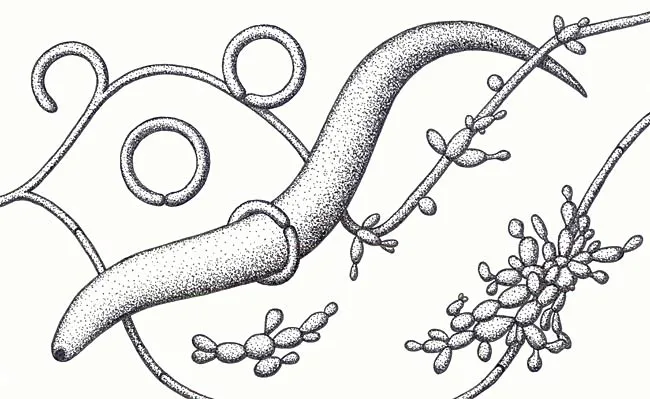
The oldest-known carnivorous fungus on the planet has been found locked within 100-million-year-old amber.
The fossil find pushes back the known existence of such predators by about 80 million years. Like a microscopic Wild West of sorts, unsuspecting nematode worms and other tiny critters were subject to being lassoed by the ancient organism lurking in forest floor soils.
"These kinds of fossils are very hard to find, and this one is fantastic," said researcher Alexander Schmidt, a biologist at the Humboldt University of Berlin. "There is Mexican amber from about 15 to 20 million years ago with carnivorous fungus in it, but it doesn't show the trapping structures very well at all."
The new hunk of amber, he said, clearly shows predatory fungi rounding up tiny nematodes — about as long as a human hair is wide — right before tree resin encased the soil ecosystem.
The fungal traps were loops made of single cells. When wormy prey happened to slip through its vices, the ring cinched down on and stuck to its query. With a nematode in its grasp, the fungi got to work by injecting hyphae, or root-like projections of cells, into its body to suck out a nutritious meal.
"It's an adaptation to gather hard-to-find nutrients in the soil ecosystem," Schmidt said, such as nitrogen.
He explained that carnivorous fungi lurk beneath the soil today, trapping tiny organisms just as they did in the Cretaceous Period.
Get the world’s most fascinating discoveries delivered straight to your inbox.
"The fungus looks similar to modern species, but it's actually quite different," Schmidt said. "I think it's amazing that for 100 million years, this unusual predatory niche in the soil has been occupied by unrelated organisms."
Schmidt and his colleagues' findings are detailed in the Dec. 14 issue of the journal Science.