













Only Two Cosmic Doomsdays Are Certain
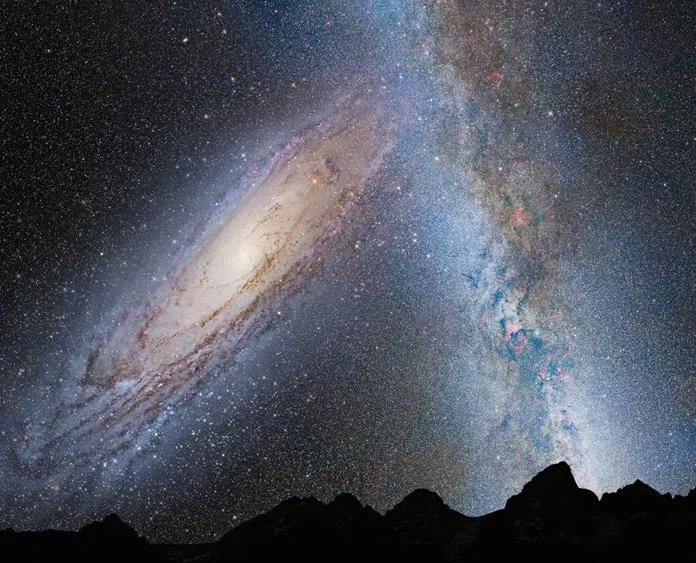
Last week's announcement of the inevitable collision of the Andromeda galaxy with the Milky Way is one of only two apocalyptic astronomical predictions that we can be absolutely certain of. The other is the death of our sun. Purely deterministic processes drive both.
The eventual galaxy smashup is the result of the inexorable pull of gravity between two heavyweight "island universes" each weighing over 1 trillion times the mass of our sun.
300 years ago, Isaac Newton could have predicted this ultimate Clash of the Titans if he simply had mass and velocity data of the two galaxies. It's as inevitable as Newton's apple falling out of a tree.
The sun will burn out 6 billion years from now, leaving Earth a cold barren cinder. And, the sun's fate this can be extrapolated to every other star in the universe. The last one winks out 100 trillion years from now.
Beyond these two irrevocable events, all other cosmic disasters are simply probabilistic. You might want to take out homeowners insurance against them, but you can still hold out hope you'll never need to cash in on your policy.

The idea that the Milky Way's head-on collision won't happen for another 4 billion years from now, is wonderfully ironic considering some folks are still sweating over many silly end-of-world predictions linked to the Mayan Calendar "ending" in 2012. The broad spectrum of cosmic disasters bandied about on the Internet stretches from possible, to improbable, to utterly impossible.
Where to begin?
Get the world’s most fascinating discoveries delivered straight to your inbox.
Statistically, a planet-killer class asteroid should whack us in less than 100 million years.
A nearby supernova could irradiate Earth within 250 million years.
Chaos theory allows for a small probability that the planets will become unstable in their orbits in a few billion years, and Earth may collide with Mars. But by then, Earth's oceans will have been evaporated away under the warming sun.
There is an infinitesimally small chance a bypassing star or rogue black hole will run into the sun. And those odd would slightly increase during the Milky Way-Andromeda collision event, although it is essentially a "collinsionless collision" -- there is a vast amount of interstellar space, so there will be few (if any) direct stellar smash-ups, although the gravitational instabilities will likely wreak dynamical chaos on galactic scales.
But wait a minute. The future technological prowess of our civilization should mitigate the worst effects of these disasters. Frankly, we deserve to become extinct if we don't have the wherewithal to come up with the money and technology to protect Earth from maundering asteroids. Call it the Cosmic Darwin Awards.
What's more, straightforward Newtonian physics could be applied to move Earth farther from the warming sun by setting up an interplanetary pinball game where we rob momentum from large asteroids and small planetary bodies to widen our orbit.
Even more farfetched, perhaps some huge space "star shade" could be built to keep Earth in a shadow from radiation from a nearby supernova.
Though we have evidence for the beginning of the universe, we can only speculate how it will -- or might -- end someday. Dark energy is the wild card here because if it is unstable over time (which it doesn’t seem to be), it could rip the universe apart or even implode space and time.
Quantum physics allows for a "phase transition" where the universe abruptly ceases to exist into a wave of nothingness that propagates across space at the speed of light.
The Milky Way-Andromeda collision is unique in that it is probably the farthest we can extrapolate into the future with any certainty.
This event needs a name that's as catchy as the Big Bang. Some ideas from my friends: The Big Bang-up, The Milky Spaly, The Milky Shakeup, and The Big Milky Spill.
But, to borrow form another proverb: there's no sense crying over it ...
This story was provided by Discovery News.