













Investigation Launched into Disputed Tyrannosaur's Origin

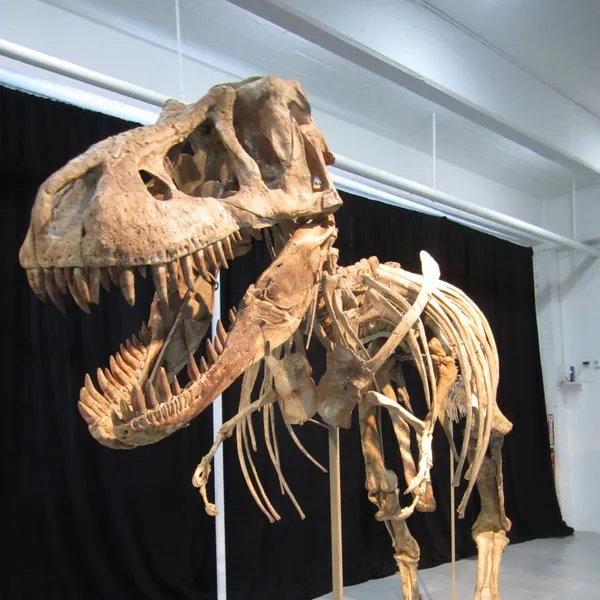
The government of Mongolia and the auction house that conditionally sold a tyrannosaur skeleton are collaborating on an investigation into whether or not the fossils were taken illegally from that country.
Heritage Auctions and the consignors of the skeleton have voluntarily given information regarding the origin and chain of custody of the three-quarters- complete specimen to the attorney representing President Elbegdorj Tsakhia, who maintains that the fossils belong to Mongolia. Meanwhile, a team of Mongolian officials and paleontologists is planning to visit the specimen, which Heritage Auctions has housed in New York City, to conduct an investigation next week.
The 8-foot-tall and 24-foot-long (2.4 by 7.3 meters) skeleton of Tarbosaurus bataar, an Asian relative of Tyrannosaurus rex, went up for auction May 20. The Mongolian President attempted to prevent the sale by filing a temporary restraining order; but Heritage Auctions went ahead, making the sale contingent on court approval. An anonymous buyer bid $1.1 million for the specimen. [Tyrannosaur vs. Tarbosaur: What's the Difference?]
At the time, attorney Robert Painter, representing the Mongolian president, said he planned to continue pursuing legal action. A joint announcement today (May 29) from both sides indicated a more amicable turn.
"Once the Mongolian government figured out we weren't interested in hiding anything and our consignor [the seller] wasn't interested in hiding anything, it was no problem coming to an agreement on how to proceed," said Jim Halperin, co-chairman of Heritage Auctions.
It's not yet clear how the outcome of the investigation will affect the pending sale.
Painter told LiveScience: "What could happen if the investigation concludes that it did originate in Mongolia, then of course the government's position would be that it needs to be repatriated. Then we would proceed with the court case or work out an amicable arrangement."
Get the world’s most fascinating discoveries delivered straight to your inbox.
The information provided by Heritage Auctions and the sellers goes back only as far as 2005, when one of the two sellers purchased the skeleton from a dealer in Japan, Painter said.
Paleontologists believe the Tarbosaurus, as well as several other fossils sold May 20, almost certainly came out of a particular rock formation exposed only in the Mongolian desert. Mongolian law makes fossils, and other artifacts, property of the state, forbidding their export.
Editor's Note: This story was updated on Wednesday, May 30 at 11:56 a.m. EDT to correct a reference to President Elbegdorj Tsakhia. His last name is Elbegdorj, not Tsakhia, as stated earlier.
You can follow LiveScience senior writer Wynne Parry on Twitter @Wynne_Parry. Follow LiveScience for the latest in science news and discoveries on Twitter @livescience and on Facebook.
