













Geologists Haul Up Deep-Earth Rock

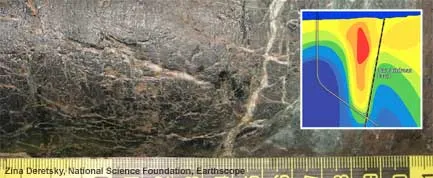
Geologists have hauled a ton of rock from more than two miles beneath the surface of California's active San Andreas Fault.
The achievement, announced at a news conference today, could help scientists answer long-standing questions about the composition and properties of the earthquake-prone fault.
"Now we can hold the San Andreas Fault in our hands," said Mark Zoback, a geologist at Stanford and member of the San Andreas Fault Observatory at Depth (SAFOD) project. "We know what it's made of. We can study how it works."
Altogether, the geologists retrieved 135 feet (41 meters) of 4-inch (10-centimeter) diameter rock cores weighing roughly one ton. The rock was hauled to the surface through a borehole measuring more than 2.5 miles (4 kilometers) long.
"To an earthquake scientist, these cores are like the Apollo moon rocks," said Steve Hickman, a U.S. Geological Survey geophysicist who was involved in the project. "Scientists from around the world are anxious to get their hands on them in the hope that they can help solve the mystery of how this major, active plate boundary works."
Previous core samples have only been obtained from ancient faults which have been laid bare and brought to the surface of the Earth by millions of years of erosion. SAFOD was begun in 2004 to obtain core samples from the still active San Andreas Fault, an 800-mile-long geological scar that runs through California. The fault marks the boundary between two large pieces of the Earth's crust: the Pacific Tectonic Plate and the North American Plate.
Scientists are interested in the San Andreas Fault because it is a prime example of the kind of plate boundary where big earthquakes are known to strike.
Get the world’s most fascinating discoveries delivered straight to your inbox.
SAFOD is funded by the National Science Foundation (NSF).
- 101 Amazing Earth Facts
- Gallery: Deadly Earthquakes Past and Present
- Natural Disasters: Top 10 U.S. Threats
