













Pregnant Monkeys Miscarry to Avoid Infanticide

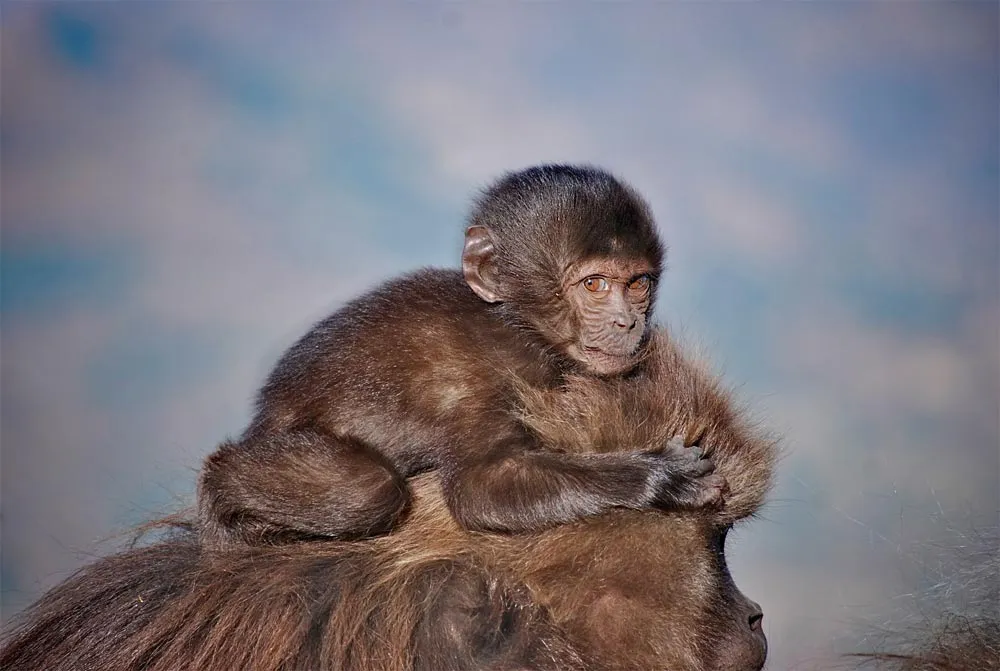
When a new male gelada monkey takes control of a reproductive group, he will typically kill off the babies of his predecessor. Now, new research shows that pregnant females have an adaptive strategy to minimize their losses: They spontaneously miscarry.
In 1959, biologist Hilda Bruce first demonstrated the so-called Bruce effect in mice, where recently pregnant females miscarry after being exposed to novel males. Since then, researchers have documented the phenomena in other rodent species. However, until now, the Bruce effect seemed to be something restricted to the laboratory, as nobody had conclusively shown that it exists in wild animal populations. Moreover, studies have not shown that there is any evolutionary advantage to miscarrying when confronted with new males.
To see if the Bruce effect exists in gelada monkeys (Theropithecus gelada), Jacinta Beehner, an anthropologist at the University of Michigan, and her colleagues tracked 110 females across 21 groups of wild geladas living in the Simien Mountains National Park in Ethiopia. [Gallery: Photos of Gelada Monkeys]
"We saw that as soon as a new male came into a group, there were no births for the next six months," Beehner told LiveScience. In fact, the researchers documented only two births in these replacement groups in the five years of the study. "We get this big gap, screaming out that something is going on — it's statistically almost impossible to get this by chance."
To be sure what they were seeing was indeed the Bruce effect, the researchers also took hormonal data from the fecal samples of females before and after a new male arrived. Out of the 10 cases of pregnancies the researchers looked at, eight of the females miscarried within two weeks of a new male coming on to the scene. Most surprising to the researchers, the miscarriages happened the same day the male took over.
ABORTION GUIDANCE AND SUPPORT
—Abortion laws by state: https://reproductiverights.org/maps/abortion-laws-by-state/
—For questions about legal rights and self-managed abortion: www.reprolegalhelpline.org
—To find an abortion clinic in the US: www.ineedanA.com
—Miscarriage & Abortion Hotline operated by doctors who can offer expert medical advice: Available online or at 833-246-2632
—To find practical support accessing abortion: www.apiarycollective.org
Of the two females that didn't miscarry, one quickly showed signs of fertility swelling and eventually mated with the new male while still pregnant. The other didn't, and probably as a result, the male killed her infant, but didn't kill the infant of the female with whom he mated. This behavior suggests that the males figure out which babies are theirs simply by knowing which females they mated with, Beehner said.
Females that miscarried as soon as new males arrived also became pregnant again, and the researchers saw a twofold increase in births during the seven to 12 months after new males took over. They also found that females that experienced such primate infanticide took longer to become pregnant again, suggesting these miscarriages are evolutionarily advantageous to the mama monkeys.
Get the world’s most fascinating discoveries delivered straight to your inbox.
Peter Brennan, a physiologist at the University of Bristol in the United Kingdom who was not involved in the research, said that the study was quite convincing. "It's a great example of pregnancy block being demonstrated quite convincingly in the wild," said Brennan, who has studied the Bruce effect in lab mice. "And there's good evidence that it's adaptive in evolutionary terms."
Brennan is curious as to exactly how the females miscarry. In lab mice, he notes, females miscarry after picking up on chemical signals put off by the new males. "The actual physiological mechanism [in geladas] may be different," he said, adding that the miscarriages might be a response to social stress.
Beehner said that the next step is to pinpoint this mechanism, though this research cannot be conducted on a threatened wild primate like the gelada. Domestic horses may be good candidates for further research, as scientists have seen the Bruce effect in the species before, she said.
Follow LiveScience for the latest in science news and discoveries on Twitter @livescience and on Facebook.
This article was updated on August 4, 2022 by Live Science contributor Alice Ball following the Supreme Court's decision to overturn Roe v. Wade on June 24, 2022. This decision eliminated the constitutional right to abortion that was established by the 1973 court case and later affirmed by a 1992 case called Planned Parenthood of Southeastern Pennsylvania v. Casey.
