














Explosive Volcano May Lurk Beneath Death Valley

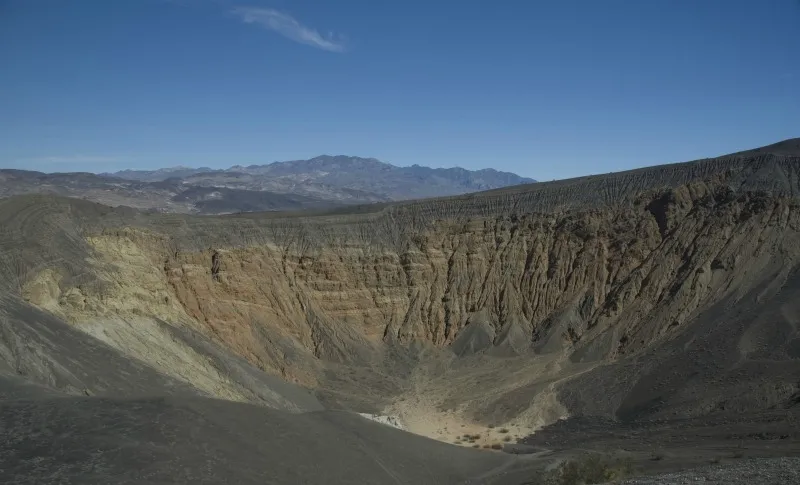
California's Death Valley, already one of the hottest places on Earth, may have the potential to get a whole lot hotter — and live up to its name in a surprising (and possibly scary) new way, according to new research.
Scientists have long known that the craters that pepper this dry landscape were formed by long-ago volcanic eruptions, triggered when hot magma ascending from inside the planet hit pockets of water.
Some researchers now think the area erupted far more recently than thought, meaning the parched swath of central California, home to desolate salt flats and scalding temperatures, could be primed for a follow-up.
Dates for the geological catastrophe are fuzzy, but researchers used to think that Death Valley's largest crater, a half-mile (0.8 kilometer) wide gash in the Earth nearly 800 feet (240 meters) deep, formed in 4000 BC.
Yet new evidence uncovered by a team of scientists at Columbia University's Lamont-Doherty Earth Observatory suggests the dramatic crater, called Ubehebe, last erupted only 800 hundred years ago.
Although that may sound like ancient history, in geological time 800 years is a mere blip. And because the crater formed relatively recently, it might still be restive, and plenty of liquid hot magma may still be lurking beneath it.
The cataclysmic explosion that formed the crater was likely a terrifying spectacle, according to the study's authors, whose work is published in the current issue of the journal Geophysical Research Letters.
Get the world’s most fascinating discoveries delivered straight to your inbox.
When the hot magma hit groundwater, the interaction likely produced a powerful explosion that smashed a hole through the overlying rocks, sending out a scalding-hot mushroom cloud of deadly gases that raced across the ground at 200 mph (320 kph). [The 10 Biggest Volcanic Eruptions in History]
"It would be fun to witness — but I’d want to be 10 miles away," said study co-author Brent Goehring, in a statement from the Lamont-Doherty Earth Observatory.
The evidence comes from chemical signatures trapped in small fragments of rocks the team gathered near Ubehebe. Dating techniques and analysis revealed that the rocks were birthed by eruptions that happen once every 1,000 years or so, and that the most recent large eruption occurred around the year 1300.
That could put the present day within the geological cross hairs, according to Nicholas Christie-Blick, a Lamont-Doherty Earth Observatory professor.
"There is no basis for thinking that Ubehebe is done," Christie-Blick said in a statement.
However, there's a good chance the crater would provide plenty of warning ahead of any deadly fireworks. The awakening volcano could set off small earthquakes and open steam vents as early as a year before an eruption, the scientists noted.
- Images: Hell on Earth – A Tour of Death Valley
- Video: Spectacular Collapse of Hawaiian Volcano Crater
- The 9 Hottest Places on Earth
Follow OurAmazingPlanet for the latest in Earth science and exploration news on Twitter @OAPlanet and on Facebook.
