















This story was updated at 11:36 a.m. EDT.
NASA's Grail mission, which is set to launch tomorrow morning (Sept. 8), should help scientists understand the moon's structure and evolutionary history better than ever before, researchers say.
The twin Grail spacecraft will map out the moon's gravitational field 100 to 1,000 times more precisely than any previous mission, NASA officials said. That information should yield unprecedented insights into Earth's nearest neighbor — what it's made of, how it formed nearly 4.6 billion years ago and how it's changed since.
"Grail, simply put, is a journey to the center of the moon," Ed Weiler, associate administrator at NASA's Science Mission Directorate in Washington, told reporters Tuesday (Sept. 6). "We will learn more about the interior of the moon with Grail than all previous lunar missions combined." [20 Most Marvelous Moon Missions]
Grail is slated to blast off at 8:37 a.m. EDT (1237 GMT) on Thursday, with a second launch window opening about 40 minutes later. Weather forecasts call for thunderstorms in the area on Thursday, however, and there's a 60 percent chance that the launch will be delayed.
The outlook is similarly gloomy on Friday, but the weather should start to improve by Saturday and Sunday, forecasters said. Grail has a 42-day launch window that runs through Oct. 19.
Moon's gravity secrets
Get the world’s most fascinating discoveries delivered straight to your inbox.
The United States and other nations have launched many missions to study the moon over the past half-century. During NASA's Apollo program, 12 people even walked and drove across the lunar surface, and brought moon rocks back to Earth.
Despite these efforts, however, our understanding of Earth's natural satellite remains relatively skin-deep, according to Weiler.
"We don't really have a good feel for lunar gravity," he said. "That can be very critical for future landing of robotic spacecraft, or even human spacecraft."
Precisely mapping out the moon's gravity field — which the $496 million Grail mission aims to do — should also yield other benefits. Specifically, it should reveal the moon's structure in great detail, allowing scientists to draw insights about how the rocky body formed and how it has changed over time, researchers said. [Photos of NASA's Grail Moon Gravity Mission]
"Aside from the sheer beauty of seeing the moon in the night sky, the moon surface holds the record of the whole history of the evolution of the moon," Maria Zuber, Grail principal investigator at MIT said in a news briefing today (Sept. 7). "A great deal of what you see on the lunar surface, however, is controlled by processes that have occurred inside the moon."
Researchers are also expecting Grail's observations to shed light on how other large objects in the inner solar system came to be.
"We intend to provide a holistic view of the origin and evolution of the moon, and by extension, how other rocky planets in the inner solar system formed," Zuber said.
Twin spacecraft at the moon
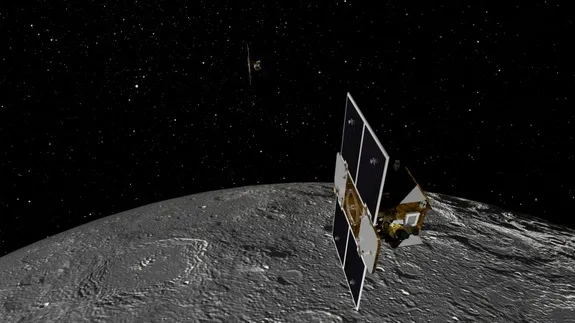
The twin Grail spacecraft, whose name is short for Gravity Recovery And Interior Laboratory, will take a circuitous, energy-efficient path to the moon, finally arriving around New Year's Day.
The two washing-machine-size probes, known as Grail-A and Grail-B, will settle into orbits just 34 miles (55 kilometers) above the lunar surface. Then they'll chase each other around the moon for three months, staying 75 to 225 miles (121 to 362 km) apart. [Video: Grail's Mission to Map Moon Gravity]
Regional differences in the moon's gravitational field will cause Grail-A and Grail-B to speed up or slow down slightly, changing the distance between them as they fly. The probes will gauge these distance variations constantly, using microwave signals they'll bounce back and forth to each other.
The Grail probes will be able to determine the distance between them with incredible precision — less than the width of a human red blood cell, said Sami Asmar, Grail deputy project scientist at NASA's Jet Propulsion Laboratory in Pasadena, Calif. Scientists will then use this information to construct highly detailed maps of the lunar gravity field.
Over the course of the three-month mission, Grail will generate three global lunar gravity maps, Weiler said.
This story was provided by SPACE.com, sister site to LiveScience. You can follow SPACE.com senior writer Mike Wall on Twitter: @michaeldwall. Follow SPACE.com for the latest in space science and exploration news on Twitter @Spacedotcom and on Facebook.
