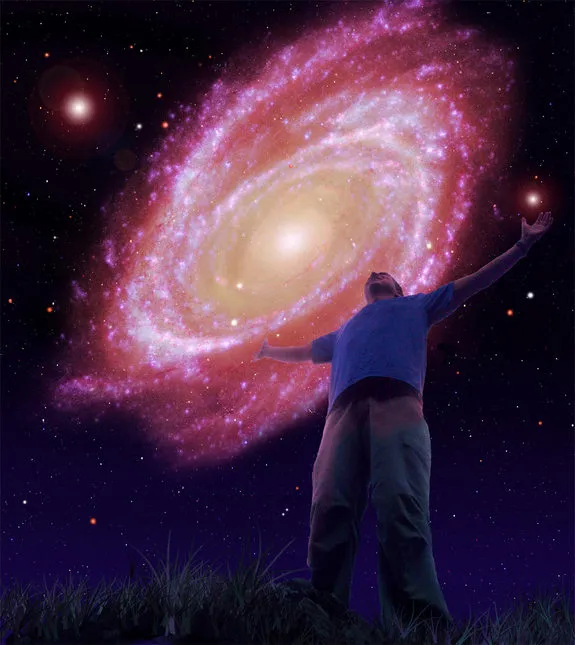
After about 5 billion years, the Milky Way will be no more. Our galaxy is set to collide with our neighbor Andromeda to create the so-called Milkomeda galaxy.
Astronomer Lauranne Lanz of the Harvard-Smithsonian Center for Astrophysics in Cambridge, Mass., is part of a team that has assembled an atlas of colliding galaxies to better understand how these cosmic train wrecks occur.
SPACE.com talked to Lanz about what's in store for the Milky Way and whether the Earth is doomed.
SPACE.com: A collision of galaxies sounds violent. Is it?
Lauranne Lanz: When two galaxies collide, the stars don't collide into each other — that's the first thing to keep in mind.
What really happens is that the stars pass through each other kind of like a mesh, but their gases do collide, and in that process, that sparks the creation of new stars because when gas becomes dense it likes to form stars.So from that point of view, it is pretty violent, and it does look quite messy, but in a very pretty way. [Stunning Photos of Galaxy Collisions]
The Andromeda Galaxy photographed with a 12.5-inch telescope by amateur astronomer Robert Gendler.
SPACE.com: So is the Milky Way definitely on a collision course?
Sign up for the Live Science daily newsletter now
Get the world’s most fascinating discoveries delivered straight to your inbox.
Lanz: Oh, definitely. We know that Andromeda and the Milky Way are going to come together in about 5 billion years, which is roughly around the time that the sun will be puffing up into a red giant, so we'll have other problems at that point.
SPACE.com: Is the Earth doomed?
Lanz: When the sun expands, the Earth is going to get quite warm. So from the point of view of the sun, we're going to have problems.
From the point of view of Andromeda, we're not going to hit any other solar system. When new stars are created, since they live relatively shortly from the point of view of stars, and when you get massive stars you get supernovae, and you don't really want all that many in your neighborhood, so that's not good for us either.
But other than that not too many bad things will happen from colliding galaxies.
SPACE.com: How do you feel about the word Milkomeda?
Lanz: It's not that bad.
SPACE.com: What is the Milkomeda system going to look like?
Lanz: Very often they'll go through a messy phase where they've got arms everywhere. But if you give them long enough they settle into an elliptical, typically.
A near galactic-collision between NGC 2207 (left) and IC 2163 captured by the Hubble Space Telescope. Scientists predict the Milky Way will merge with its neighbor Andromeda in about 5 billion years.
(Image credit: NASA and The Hubble Heritage Team (STScI))
Are there usually signs of the galactic train wreck afterward?
SPACE.com: Lanz: If you look long enough after the collision, you're not going to see any traces.
One of the earlier projects that I did is looking at a system that had had a collision. It had a lot more dust than it should, which told us that it ate a spiral that had dust. So that's one way that you can potentially tell if a system has had a collision — if it's got stuff that you don't expect that type of galaxy to have.
SPACE.com: How common are galaxy collisions?
Lanz: As we understand the growth of galaxies over the entire age of the universe, we really think that small ones form and then clump together to form bigger ones. So really any large galaxy will have had multiple of these events.
Whether it's events with other large ones is unclear, but they've definitely had [collisions] themselves with tiny little ones that they eat up.
This story was provided by SPACE.com, sister site to LiveScience. You can follow SPACE.com Senior Writer Clara Moskowitz on Twitter @ClaraMoskowitz.Visit SPACE.com for the latest in space science and exploration news on Twitter @Spacedotcom and on Facebook.
Clara has a bachelor's degree in astronomy and physics from Wesleyan University, and a graduate certificate in science writing from the University of California, Santa Cruz. She has written for both Space.com and Live Science.