













Crabs Shack Up in Safe Sandcastles

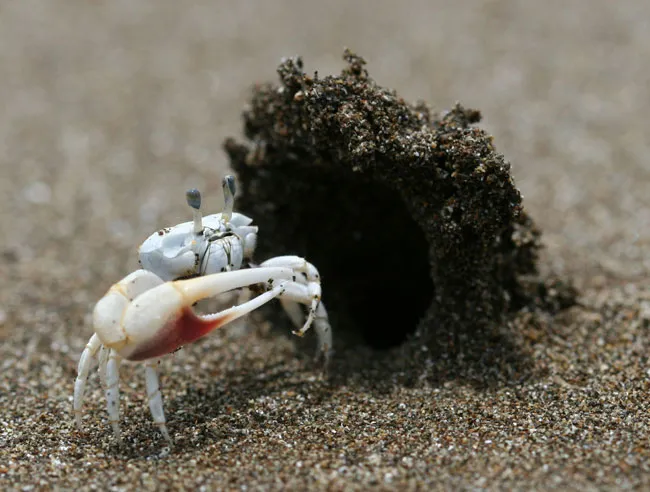
Female fiddler crabs find male suitors more attractive if the chaps can arrange safe sand castles for booty calls, new findings suggest. In the animal kingdom, females are often attracted to outrageously showy displays such as a peacock's plumage. If gaudy males can escape from predators despite their flamboyant ornaments and behavior, such daredevil living helps prove their worth as a mate. Still, if females are constantly in danger of getting eaten by predators, flashy displays that flaunt safety instead of risk also might win hearts, reasoned John Christy, a staff scientist at the Smithsonian Tropical Research Institute in Panama. He and his colleagues found such caution-driven courtship in a species of fiddler crab (Uca terpsichores) in which the males build sand castles next to the entrances of their burrows on the intertidal flats of the Panama Canal's Pacific side. They attract the attention of females to their beach homes by waving the one super-sized claw they possess in the air. When female crabs leave the security of their homes to check out potential mates, they risk getting devoured by predatory shorebirds. To see if females preferred males that made them feel safe, Christy's colleague Tae Won Kim, a behavioral ecologist now at Ewha Womans University in Korea, designed a way to lure predators to the crabs. The researchers saw that females normally preferred males that built fortresses to ones that did not. When dog kibble was spread on the sand as bait for birds called Great-tailed Grackles (Quiscalus mexicanus), "artificially increasing the risk of predation, females show an even greater preference for males who have built hoods," Christy said of findings he, Kim and their colleague Jae Chun Choe at Ewha Womans University detailed online May 9 in the journal PLoS ONE. Using just the right amount of kibble was hard, Kim recalled. "It is relatively easy to attract dozens of birds, but this level of perceived risk is so high that crabs just stay in their burrows and neither court nor seek mates," Christy told LiveScience. "Tae Won very successfully and with considerable 'art' developed a sense of just how much food to add to increase the perceived risk but not shut down social behavior all together." Scientists usually think male displays advertise their qualities as mates. These new findings suggest some displays "may simply allow choosy females to stay safe," Christy suggested. He also thought the male crabs originally built the castles to help them find their own burrows, and the fact that females also happened to get drawn to them was incidental and fortuitous. The fact that a female might choose a mate based on displays that actually benefit her directly "is a fundamentally new and perhaps widely applicable idea," Choe said. Similar findings might be seen in species in which males decorate shelters for mating or guard against predators, Kim added.
- Why Do People Kiss?
- Mating Game: The Really Wild Animal Kingdom
- How Women Pick Mates vs. Flings
Get the world’s most fascinating discoveries delivered straight to your inbox.
