













50 Fabulous 4th of July Facts: Fiery Fireworks

Sky Lights
Each day through July Fourth, LiveScience brings you some of the most fascinating, little-known facts about America's celebration of independence.
[Read: 50 Fabulous 4th of July Facts: \The 13 Original Colonies, Come Celebrate! and All About Patriotism]
Static Cling

The static electricity in synthetic clothing can unleash sparks that could detonate fireworks, those who make the shells must wear cotton clothing (all the way down to their underwear!), according to Wichita State University.
Cool Colors

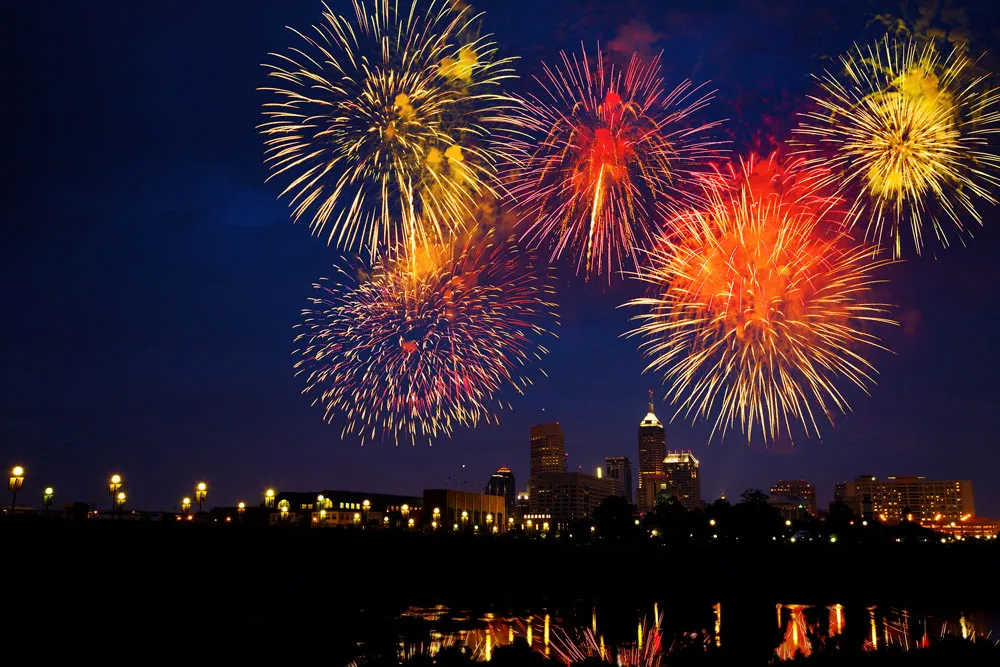
The dazzling colors that light up Fourth of July skies depend on the mix of metals inside the fireworks:
- Copper produces blue sparks;
- A mix of strontium salts, lithium salts and other substances makes red;
- Aluminum and titanium put the white stars in an aerial flag;
- Barium makes green;
- Calcium burns orange and sodium, yellow.
Big Business

Fireworks are big business. According to the U.S. Census Bureau, America imports $190.3 million worth of fireworks each year, almost all from China. The U.S. itself makes $231.8 million of fireworks and pyrotechnics each year.
Top This!

The largest fireworks display on record took place in Madeira, Portugal in December 2006. During the show, 66,326 fireworks went off.
The largest fireworks display on record took place in Madeira, Portugal in December 2006. During the show, 66,326 fireworks went off.
Lights ... Boom!
You brain isn't playing tricks on you. … You really do see the sky light up before you hear the “boom.” That's because light travels about a million times faster than sound. While light trucks along at a whopping 300,000,000 meters per second, sound chugs at 340 meters per second. To figure out how far away the fireworks are, start counting seconds as soon as you see them light up the sky and stop counting once you've heard the explosion. Divide by 3 and that’s the distance in kilometers.
Get the world’s most fascinating discoveries delivered straight to your inbox.
Hot Stuff

Sparklers, which are commonly used by children, burn at temperatures upward of 2,000 degrees Fahrenheit (1,093 degrees Celsius). In 2003, sparklers caused 700 injuries, according to the Consumer Product Safety Commission (CPSC). More than half of injuries of children under 5 were caused by sparklers.
Caution, Please
Between June 18 and July 18, 2010, there were about 6,300 fireworks-related injuries in the U.S., according to the U.S. Consumer Product Safety Commission (CPSC). An estimated 1,200 injuries were associated with sparklers and 400 with bottle rockets.
Boo-Boos

The parts of the body most often injured from fireworks, based on the 2010 CPSC study, were hands and fingers (estimated 30 percent); legs (estimated 22 percent); eyes (estimated 21 percent); and head, face and ears (estimated 16 percent).
Leave it to the Professionals
But despite the dangers of fireworks, the injury rate has actually gone down 37 percent since 1991, the CPSC found. These days, about 3 out of every 100,000 people gets injured by a firework. The decreased injury rate may be due to people's preference for large, professional fireworks displays rather than backyard pyrotechnics.
Falling from the Sky

All of the propellants, oxidizers and coloring agents that go into dazzling light shows on July Fourth leave a smoky skeleton in the sky that ends up in the area’s soils and waterways.

Stephanie Pappas is a contributing writer for Live Science, covering topics ranging from geoscience to archaeology to the human brain and behavior. She was previously a senior writer for Live Science but is now a freelancer based in Denver, Colorado, and regularly contributes to Scientific American and The Monitor, the monthly magazine of the American Psychological Association. Stephanie received a bachelor's degree in psychology from the University of South Carolina and a graduate certificate in science communication from the University of California, Santa Cruz.