














Japan's Tsunami: How It Happened

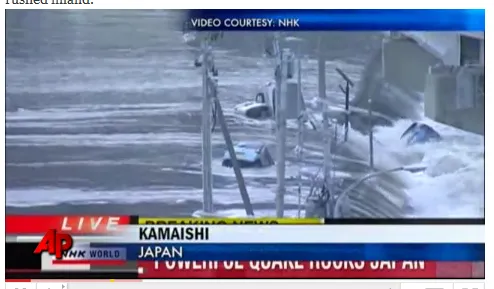
Tsunamis, such as the one generated by the magnitude 8.9-magnitude earthquake that struck Japan today (March 11), are often generated by massive ruptures beneath the Earth’s surface underneath the ocean floor.
When the earthquake ruptures along a fault line, the surface around that fault is pushed up and then dropped back down. (Not all undersea quakes generate tsunamis, as some occur so deep in the Earth's crust that they won't cause this push.) That movement displaces the entire water column above that chunk of the surface.
"This is the most common way to generate a tsunami," said Aggeliki Barberopoulou of the University of Southern California's Tsunami Research Center, who is monitoring the current tsunami as it affects California.
The earthquake near the east coast of Honshu, Japan, ruptured at 05:46 GMT (2:46 p.m. local time), immediately putting in motion the tsunami. [Tsunami Warnings: How to Prepare]
Wave begins
The energy put into the vertical movement of the water (as the chunk of earth moves up and then back down) is transferred into horizontal movement — a massive wave that can travel the span of an ocean basin in a matter of hours.
Within several minutes of the earthquake, the initial tsunami is split into a tsunami that travels out to the deep ocean, in this case toward Hawaii and the U.S. West Coast, and another tsunami that travels toward the nearby coast, in this case, Japan.
Get the world’s most fascinating discoveries delivered straight to your inbox.
The waves hit the eastern coast of Japan about 1.5 hours after the quake, Barberopoulou said. The 23-foot (7-meter) tsunami swept away boats, cars, homes and people, according to news reports. So far 88 people have been confirmed killed and hundreds more are missing.
"I was actually shocked" to see all the damage the waves had caused, Barberopoulou told OurAmazingPlanet, because the damage didn't match up with initial estimates of the earthquake's magnitude, which were a magnitude lower than current estimates.
Deep vs. shallow water
The speed at which tsunamis travel depends on the depth of the water, so the wave propagating across the deep ocean will travel faster than the one headed toward the nearby shore.
"The tsunami wave speed in deep water, open ocean, is about the same as a commercial jet's ground speed," said Ken Hudnut, a geologist with the U.S. Geological Survey in Pasadena, Calif.
The tsunami has already hit the tiny North Pacific island of Midway, which lies about 1,300 miles (2,100 kilometers) northwest of Honolulu, with waves up to 5 feet (1.5 meters) high, according to news reports. The waves have also already arrived at Hawaii in the wee hours of the morning there, but did not seem to be as large as the original 6 feet predicted, according to the Associated Press. Coastal residents were evacuated.
The tsunami warning for Hawaii continues, and is set to expire around 7 a.m. HAST (12 p.m. EST).
Tsunami impacts in Alaska have been minimal so far, according to the Weather Channel.
Waves are predicted to hit the western coast of the United States between 11 a.m. and 11:30 a.m. EST (8 a.m. and 8:30 a.m. PST) Friday. The tsunami has begun to arrive in Southern California and the threat will continue for several hours. Waves have also been reported along the Oregon coast, near the California border. It will be several hours after this initial time before tsunami watchers will be able to say the threat is over, Barberopoulou, who is monitoring tide gauge reports across California, said.
Tsunamis can travel so far across the ocean because there is little in there way to slow them down.
"There's not much friction going on when you travel over the ocean," Barberopoulou explained.
Tsunamis at sea and shore
Tsunamis at sea are not the monster waves that might be imagined — they are at most a few meters high and are spread over tens to hundreds of kilometers. [Album: Monster Waves]
As the tsunami approaches a shoreline, where the rise of the continental slope means water levels are shallower, the wave begins to narrow and become higher.
Waves, of course, have two parts: the peak and the trough. With a tsunami, the trough (the low point of a wave) is the first part to arrive, causing the sea to recede far from the shore — a telltale sign of an impending tsunami.
Next, the peak of the wave hits the shore — a process called runup. Except for the largest tsunamis, such as the 2004 Indian Ocean event, most tsunamis do not result in giant breaking waves (like normal surf waves at the beach that curl over as they approach shore). Most tsunamis come in like a very fast-moving high tide.
The small number of tsunamis that do break often form vertical walls of turbulent water called bores. Tsunamis will often travel much farther inland than normal waves.
The physical characteristics of a shoreline can determine what form a tsunami's waves will take when it hits. Relatively smooth, straight coastlines, as are often found in Southern California, will generally see smaller waves, Barberopoulou said. Coasts with many inlets can complicate matters and bring higher waves, as is predicted to be the case in Northern California.
The features on the ocean bottom can also affect how a tsunami will behave when it reaches shore. Certain features can focus the wave and cause it to be higher, Barberopoulou said.
Not over yet
Most of the damage inflicted by a tsunami is caused by the strong currents it produces and floating debris.
The tsunami doesn't end once it's broken on shore, either. After runup, part of the tsunami energy is reflected back to the open ocean and scattered by sharp variations in the coastline.
In addition, a tsunami can generate a particular type of coastal trapped wave called edge waves that travel back-and forth, parallel to shore.
These effects of the tsunami can cause it to arrive in multiple waves, instead of one large one. The first runup of a tsunami is often not the largest.

Andrea Thompson is an associate editor at Scientific American, where she covers sustainability, energy and the environment. Prior to that, she was a senior writer covering climate science at Climate Central and a reporter and editor at Live Science, where she primarily covered Earth science and the environment. She holds a graduate degree in science health and environmental reporting from New York University, as well as a bachelor of science and and masters of science in atmospheric chemistry from the Georgia Institute of Technology.