 Live Science Plus





You are now subscribed
Your newsletter sign-up was successful
Want to add more newsletters?

Delivered Daily
Daily Newsletter
Sign up for the latest discoveries, groundbreaking research and fascinating breakthroughs that impact you and the wider world direct to your inbox.

Once a week
Life's Little Mysteries
Feed your curiosity with an exclusive mystery every week, solved with science and delivered direct to your inbox before it's seen anywhere else.

Once a week
How It Works
Sign up to our free science & technology newsletter for your weekly fix of fascinating articles, quick quizzes, amazing images, and more

Delivered daily
Space.com Newsletter
Breaking space news, the latest updates on rocket launches, skywatching events and more!

Once a month
Watch This Space
Sign up to our monthly entertainment newsletter to keep up with all our coverage of the latest sci-fi and space movies, tv shows, games and books.

Once a week
Night Sky This Week
Discover this week's must-see night sky events, moon phases, and stunning astrophotos. Sign up for our skywatching newsletter and explore the universe with us!
Join the club
Get full access to premium articles, exclusive features and a growing list of member rewards.
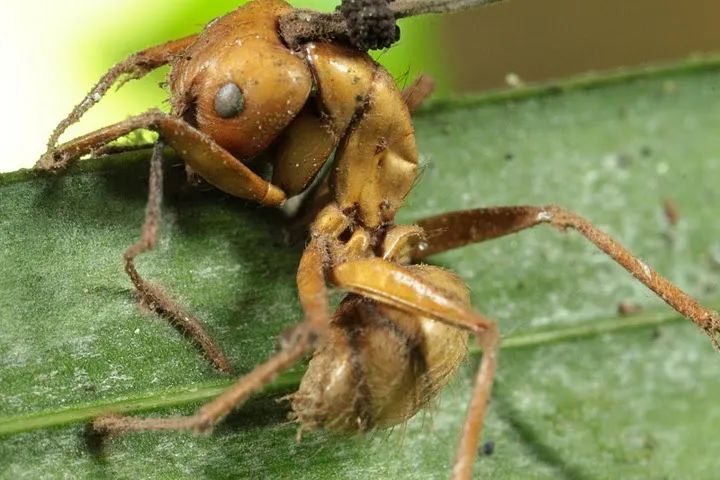
The world just got a little weirder: Scientists have identified four new species of brain-controlling fungi that turn ants into zombies that do the parasite's bidding before it kills them.
Identified from samples collected at two sites in Brazil's tropical rain forest, each of the four species specializes in controlling a different species of carpenter ant.
"So we knew, right off the bat, there was a range of other species within that," said study researcher David Hughes, an entomologist at Pennsylvania State University. "I think it will turn out to be in the hundreds."
Once it infects an ant, the fungus uses as-yet-unidentified chemicals to control the ant's behavior, Hughes told LiveScience. It directs the ant to leave its colony (a very un-ant-like thing to do) and bite down on the underside of a leaf — the ant's soon-to-be resting place. Once it is killed by the fungus, the ant remains anchored in place, thanks to its death grip on the leaf.
Ultimately, the fungus produces a long stalk that protrudes from the ant's head, shooting spores out in the hopes of infecting other ants. Two of the four newly discovered species also sprouted smaller stalks elsewhere, including from the victim's feet and lower leg joints – the equivalent of knees.
The spores of the four species also had distinct features and germination processes.
Hughes is concerned that one of the four fungus species, O. camponoti-novogranadensis, may not be around for much longer. During their visits to Brazil, Hughes and his colleagues saw that the high-elevation site where the species was found had become markedly drier and hotter. Hughes attributed the change in conditions at the Parque Estadual de Itacolomi, which is near the World Heritage Site Ouro Preto, to global warming.
The ants can survive this shift in the local climate, but "the fungus can't," he said. "What we think we will see is the extinction event of the fungus we just managed to describe." (Hughes said fungi are essential aquatic organisms living in terrestrial environments, making them extra-sensitive to a drying climate.)
The research by Hughes and colleagues Simon Elliot and Harry Evans appears online today (March 2) in the journal PLoS ONE.
You can follow LiveScience writer Wynne Parry on Twitter @Wynne_Parry.

