













A Small Nuclear War Would Stall Global Warming

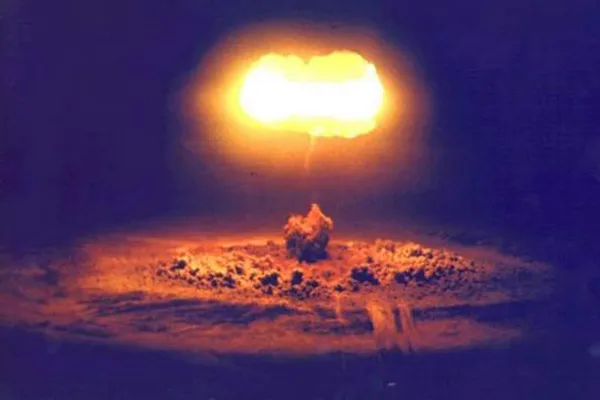
NASA computer models reveal what a small, regional nuclear war in one part of the world would do to the global climate and environment. The results are grim.
If 100 Hiroshima-sized bombs, each as powerful as 15,000 tons of TNT, were exchanged in a war between two developing-world nuclear powers such as India and Pakistan, models show the resulting fires would send five million metric tons of black carbon into the upper troposphere - the lowest-altitude layer of the atmosphere.
There, the soot would absorb solar heat and rise like a hot-air balloon, reaching heights from which it would not easily settle back to the ground.
In the shade of this carbon shield, Earth would cool. "The effects would [lead] to unprecedented climate change," said NASA physical scientist Luke Oman at a meeting of the American Association for the Advancement of Science last week. Oman's and his colleagues' models show that for two to three years after a regional nuclear war, average global temperatures would drop by at least 2.25 degrees F (1.25 degrees C), and as much as 5.4 to 7.2 degrees F (3 to 4 degrees C) in the tropics, Europe, Asia and Alaska.
But the reversal of the global warming trend wouldn't be a good thing. "Our results suggest that agriculture could be severely impacted, especially in areas that are susceptible to late-spring and early-fall frosts," said Oman, who compared the likely post-war crop failures and famines to those that followed the 1815 volcanic eruption of Mount Tambora in Indonesia.
Additionally, the models showed global precipitation would reduce by 10 percent globally for one to four years, and the ozone layer would thin, resulting in an influx of dangerous ultraviolet radiation. These results confirm predictions made previously by researchers at the University of Colorado, Boulder.
One hundred Hiroshima-sized bombs make up a mere 0.03 percent of the worldwide nuclear weapons arsenal.
Get the world’s most fascinating discoveries delivered straight to your inbox.
This article was provided by Life's Little Mysteries, a sister site of LiveScience. Follow Natalie Wolchover on Twitter @nattyover

Natalie Wolchover was a staff writer for Live Science from 2010 to 2012 and is currently a senior physics writer and editor for Quanta Magazine. She holds a bachelor's degree in physics from Tufts University and has studied physics at the University of California, Berkeley. Along with the staff of Quanta, Wolchover won the 2022 Pulitzer Prize for explanatory writing for her work on the building of the James Webb Space Telescope. Her work has also appeared in the The Best American Science and Nature Writing and The Best Writing on Mathematics, Nature, The New Yorker and Popular Science. She was the 2016 winner of the Evert Clark/Seth Payne Award, an annual prize for young science journalists, as well as the winner of the 2017 Science Communication Award for the American Institute of Physics.