Pest and Virus Cooperate in Global Invasion

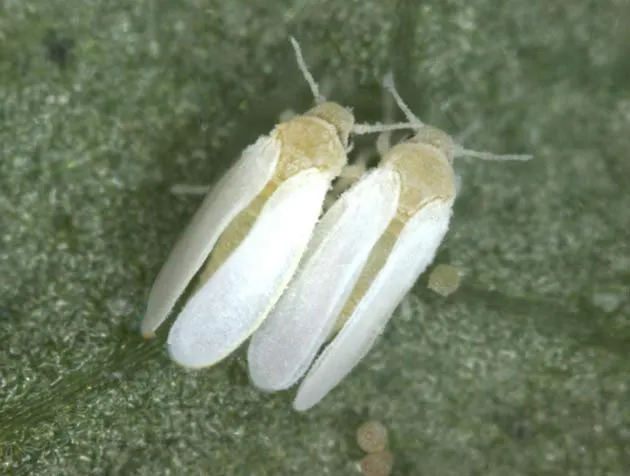
A rapidly spreading crop pest is teaming up with a virus to speed up both their invasions across the globe, scientists in China reported today.
A variety of the whitefly Bemisia tabaci known as the B biotype is "a super-invasive organism," Shu-Sheng Liu, an entomologist at Zhejiang University in Hangzhou, China, explained.
In the past 20 years, the B whitefly [image] has spread rapidly around the world to become a major pest causing hundreds of millions of dollars in crop losses. Moreover, outbreaks of the B whitefly have often been followed by pandemics of a group of plant viruses, called begomoviruses, that the whiteflies carry.
- Image Gallery: Invasive Species
Origins of the pest
It is now widely accepted that this whitefly most likely originated in the Mediterranean or North Africa, with its recent widespread invasion assisted by the international flower trade. Scientists around the globe have investigated what makes the B whitefly so invasive and how it so readily displaces native varieties of whitefly.
"I have been going to the vegetable farms for many years and was very surprised to see the rapid, devastating invasion by the whitefly in our region in 2002 and 2003, something I had never seen before," Liu told LiveScience. "It was very bad news for the farms, but as an entomologist I was also fascinated by the invasion—I wanted to find out why."
Liu and his colleagues experimented with a native Chinese whitefly and the B whitefly. The flies were exposed to both virus-infected and healthy tobacco plants.
Get the world’s most fascinating discoveries delivered straight to your inbox.
The researchers discovered the invasive B whitefly had six to seven times greater longevity and 12 to 18 times greater fertility when feeding on infected plants than on healthy ones. The population levels of the B whitefly on infected plants reached two to 13 times that on healthy tobacco in eight weeks. In comparison, it made no difference whether the native whitefly fed on healthy or virus-infected plants.
"This is the first study that shows an invasive insect has such a mutualistic relationship with the viruses it transmits, whereas its indigenous counterpart does not," Liu said.
Helpful virus
The scientists speculated that the virus could aid B whiteflies by breaking the plant down and thus freeing up amino acids for the pests to feed on. Alternatively, the researchers suggest the virus could suppress the plant's defenses against the whitefly.
The researchers added that such virus-pest partnerships might exist often in nature. Scientists should keep a lookout for them when responding to biological invasions, Liu added.
Liu and his colleagues reported their findings online today in the journal PLoS ONE.