













My Grand Gene Scheme: Hair Today, Gone Tomorrow
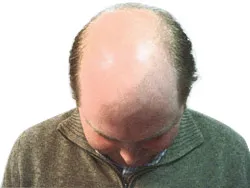
Hold onto your hats, ladies and gentlemen, because your scalps are about to get a whole lot colder – assuming my newest hair-raising world domination scheme goes according to plan. I intend to use recent genetic research to unleash a pandemic of baldness that shall sweep the world, and no amount of hairspray will keep my devilish machinations from falling into place.
This fiendish plot would be impossible without some new work from Angela Christiano of Columbia University Medical Center. Her team's efforts have teased out the genetic basis of alopecia areata, an autoimmune disease that causes patches of hair loss on the scalp and all over the body.
Among the responsible genes is one that codes for ULBP3, a protein that marks tissues for rapid destruction by lymphocytes (white blood cells that help the body defend against diseases). The protein functions by attracting the marker NKG2D, found on the surface of killer lymphocytes. A typical hair follicle has no need to produce this death-wish protein, but in people with alopecia areata, their follicles express the gene, begging to be attacked.
Christiano and other alopecia researchers are particularly excited about this finding, because NKG2D signaling is already well understood for its involvement in rheumatoid arthritis and type 2 diabetes. Drugs targeting these pathways are already in development, and could conceivably be used in treatments for alopecia areata.
Of course, I have some very different ideas about how to use this research. Christiano's team has shown that simply by expressing the gene for ULBP3, a hair follicle can seal its own doom. This means that if I can manage to cause billions of hair follicles on heads worldwide to express the gene for ULBP3, I can destroy all the world's hairdos in one fell swoop!
So I'll engineer a virus that contains the gene for ULBP3, which can inject its DNA directly into follicles. Then I'll mix the virus up with a new line of hair products and market the depilatory shampoo worldwide. I'll even send out free samples. Within weeks, the virus will have infected billions of scalps, causing all the world's craniums to become as smooth and shiny as hard-boiled eggs.
Once everyone finds out I'm responsible for their receding hairlines, they will turn to me in order to put an end to it. After all, I'll be the only one with the specially engineered conditioner, laced with a virus that stops cells from expressing the ULBP3 gene. And believe me, if the whole world knows I'm the only one standing between them and their hair, they'll be willing to do anything I say to regain their cherished locks.
Get the world’s most fascinating discoveries delivered straight to your inbox.
- More Mad Scientist: How to Generate Tropical Storms: Just Add Phytoplankton
- 5 Myths About the Male Body
- Why Do Men Go Bald?
Mad scientist Eric Schaffer has one index finger on the "fire death ray!" button and his other index finger on the exciting pulse of scientific research. His accounts of diabolical machinations, as well as research breakthroughs, appear regularly on LiveScience.