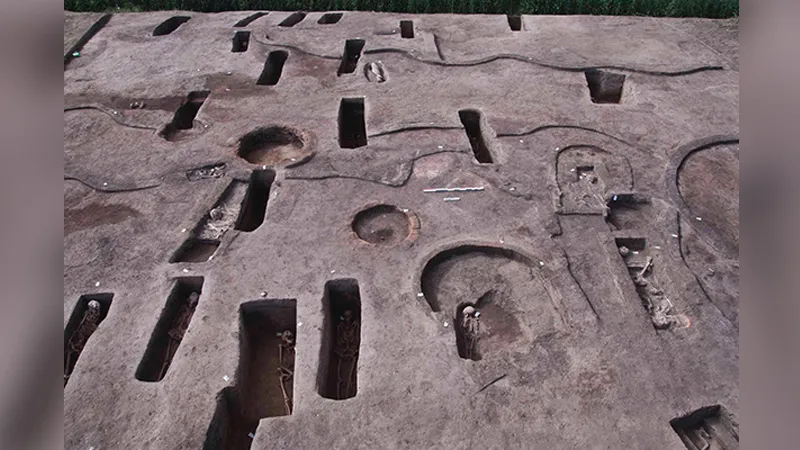
Archaeologists have unearthed 110 ancient Egyptian tombs, many holding the remains of humans, including two babies inside pots, along the Nile Delta, the Egyptian antiquities ministry announced Tuesday (April 27).
The tombs were excavated at a site called Koum el-Khulgan, which is located about 93 miles (150 kilometers) northeast of Cairo. Of those tombs, 73 date back to between 5,500 and 5,000 years ago, a time when Egypt was in the process of unifying. During this time, hieroglyphics first appeared in Egypt and a central government would form — one that would eventually be powerful enough to oversee the construction of pyramids.
Many of the 73 tombs were oval-shaped, with the human remains buried in a squatting position with the head facing toward the west, a direction where the ancient Egyptians believed the dead dwelled, the ministry said in the statement. Inside one of the tombs was the skeleton of a baby interred in a pot. The grave goods in these tombs mainly consisted of pottery vessels, including a bowl decorated with geometric shapes.
The other 37 tombs date to roughly 1640 B.C. to 1540 B.C., or between about 3,660 and 3,560 years ago, a time when the Hyksos, a group from Asia, ruled northern Egypt, the ministry said. These tombs tended to be rectangular in shape and held human remains placed inside in an extended position, the head also facing toward the west. One of these tombs also contained a baby buried inside a pot.
Silver rings had been buried with some of the human remains in these rectangular tombs; inside one tomb, the team also found what appears to be a seal stone with a hieroglyphic inscription on it. Ancient Egyptian officials commonly placed such seals — made by pressing a decorated stone into clay —onto a document or other official object. The writing and drawings on the seal could identify which official created it.
The remains of ovens, brick buildings and amulets, including scarabs made from semi-precious stones, were also found at the site. Excavations and analysis of the site are ongoing.
Sign up for the Live Science daily newsletter now
Get the world’s most fascinating discoveries delivered straight to your inbox.
Owen Jarus is a regular contributor to Live Science who writes about archaeology and humans' past. He has also written for The Independent (UK), The Canadian Press (CP) and The Associated Press (AP), among others. Owen has a bachelor of arts degree from the University of Toronto and a journalism degree from Ryerson University.