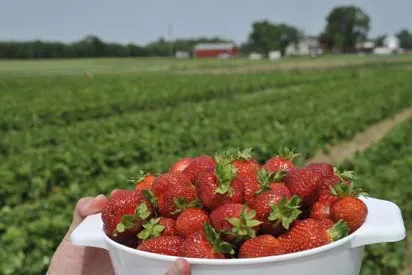
Some 50 years ago, when consumers turned from local markets to grocery stores, the strawberry lost its burst of flavor. Now researchers say the newly sequenced genome of the woodland strawberry, a relative of the cultivated berry, may help bring back the fruit's tasty tang.
"Traditionally, strawberries have been bred for disease resistance, for firmness and for size and yield, and that doesn't mention flavor and sweetness and all the really good table attributes," said Kevin Folta, an associate professor of horticulture at the University of Florida. Because of this trend, strawberries have become more watery and lost the flavors people remember from childhood, he said.
These grocery-store berries had to withstand the perils of shipping while also appealing to consumers' expectations for the perfect berry.
Latest Videos From
The distinctive flavor and sensory experience we associate with strawberry is the result of many substances produced in the berry, as well as its sugar content, acidity and color. Research has begun to unlock their genetic underpinnings, and having access to the woodland strawberry's genetic code will accelerate things, according to Folta.
For example, the molecule methyl anthranilate occurs in strawberries, as well as concord grapes. Although consumers like strawberries with it, its presence remains limited in cultivated strawberries.
"When you have the genome, you can ask what possible genes are behind the synthesis of this compound," Folta said.
The strawberry became a crop only relatively recently, about 250 years ago. The woodland strawberry, Fragaria vesca, is found throughout the Northern Hemisphere and was already present in European gardens when explorers began encountering other varieties in the New World. In the 1700s, a French spy named Captain Amédée Frézier brought back a Chilean strawberry; however this new arrival produced little fruit, according to the book "Temperate Fruit Crop Breeding: Germplasm to Genomics" by James Hancock (Spring, 2010).
However, when crossed with a strawberry brought from North America, it produced what became the modern variety. These hybrids emerged across Europe, including at the Palace of Versailles, where the botanist Antoine Nicholas Duchesne worked. He identified this hybrid, and in appreciation of this new strawberry's pineapple-like flavor, he named it Fragaria x ananassa (ananas is the French word for pineapple), Hancock writes. This is the same variety that appears in grocery stores today.
While some wild strawberries, like the woodland strawberry, have small genomes, others have more complex genomes, including the cultivated strawberry. In fact, the cultivated strawberry is among the most genetically complex crop plants, according to the researchers who sequenced the genome.
The genome the researchers sequenced belonged to the Hawaii 4 variety of the woodland strawberry. Because it has only two sets of chromosomes (or two copies of its genes), it is much easier to use for genetic studies, according to Folta.
The sequence will also have relevance for other economically important plants, like peaches, almonds, apples, raspberries, blackberries and other members of the rose family to which the strawberry belongs. Genes within this family are quite similar, according to Folta.
But by comparison to the others, the strawberry takes up little space and has a short generation time, making it a more agile model for experiments, he said.
The sequencing project was initiated at Virginia Tech, where researchers had already done genetic work on this variety of strawberry. The sequencing was done without national grants. Instead, funding came internally from the research institutions and the strawberry industry, and most of the researchers involved donated time, according to Folta, who said he acted as a coordinator for the project.
An article describing the project was published online today (Dec. 26) the journal Nature Genetics. Genomic science takes a particularly delicious turn in this issue of the journal; the strawberry appears along with the announcement that the genome of a variety of cacao plant grown to produce fine chocolate, has also been completed.
You can follow LiveScience writer Wynne Parry on Twitter @Wynne_Parry.

 Live Science Plus